
Researches
& updates
& updates
Ongoing
1973 Porsche Carrera 911 RSR
NEW FEATURE
Chassis no.
*911 3 600921*
Engine no.
*6930132*
Coachbuilder
Porsche
Beacon
ON/OFF
ON/OFF
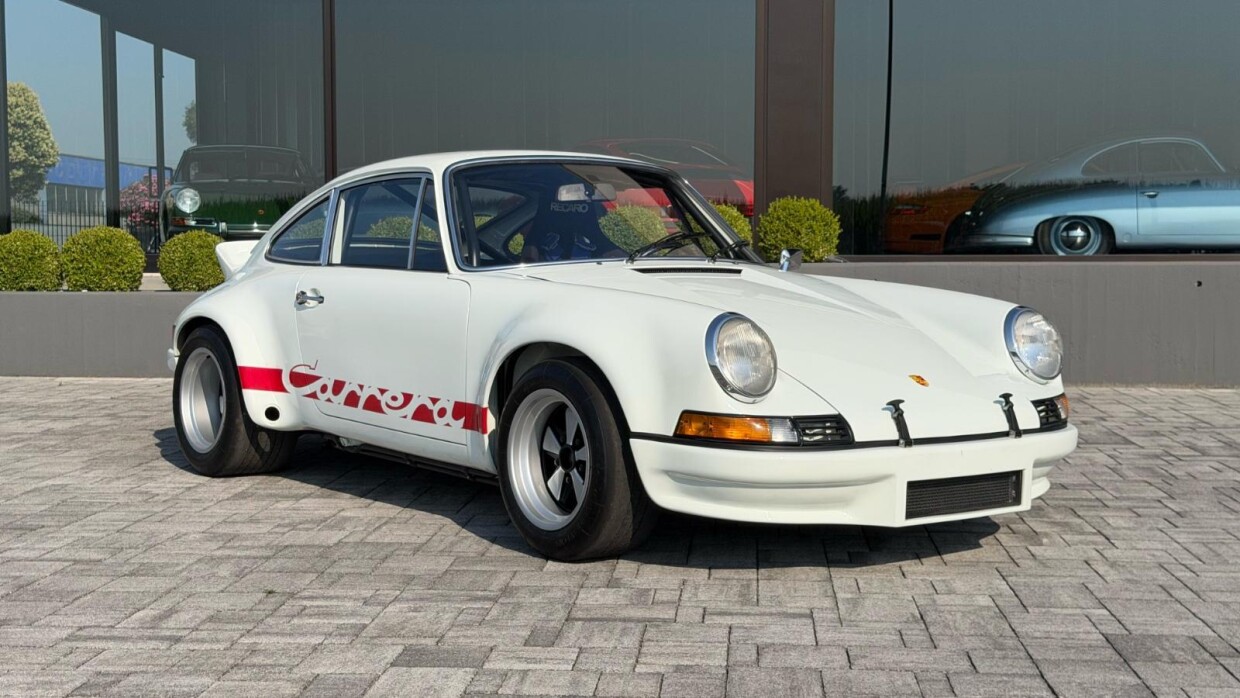
Raced by Manfred Weissmann Racing with Günter Steckkönig; strong DRM results in 1973. Later upgraded to 3.0 litres and successfully hill-climbed by Edgar Kaib.
Why am I an Automotive Masterpiece?
A. Concept and show cars
B. Prototypes
C. One-off models
D. Remaining cars from extremely limited production runs
E. Historic event cars
F. Cars owned by famous people
G. Team cars
H. Works cars
I. Press cars
J. Movie cars
K. Famous chassis’ cars
L. Limited edition cars
G. Team cars
MANFRED WEISSMANN RACING
L. Limited edition cars
no. 55 manufactured. 1973 model year. Porsche records a total production of 55 cars.
The Porsche 911 is a two-door, 2+2 high performance sports car made since 1963. At the IAA (Frankfurt Motor Show) in September 1963, Porsche presented its much more powerful, larger, more comfortable successor to the Porsche 356 as the 901. After 82 cars built and a dispute with Peugeot, Porsche renamed the 911 for its market launch in 1964. The styling was largely by Ferdinand "Butzi" Porsche, son of Ferdinand "Ferry" Porsche. Erwin Komenda, the leader of the Porsche car body construction department, was also involved in the design. Its air-cooled six-cylinder boxer engine (1991 cc) delivered 130 hp, giving it an impressive top speed of 131 mph. In 1966 Porsche presented the 160 hp 911 S (stands for Super), which was the first to feature forged alloy wheels from Fuchs. The 911 Targa, with its distinctive stainless steel roll bar, made its debut in late 1966 as the world's first ever safety cabriolet. The semiautomatic Sportomatic four-speed transmission joined the lineup in 1967. With the 911T of the same year, and the later E and S variants, Porsche became the first German manufacturer to comply with strict US exhaust emission control regulations. The Porsche 911 became more and more powerful as displacement increased, initially to 2.2 liters (1969) and later to 2.4 (1971). 911 S models also gained a discreet spoiler under the front bumper to improve high-speed stability. With the car's weight only 1050 kg, these are often regarded as the best classic mainstream 911s. For racing at this time, Porsche developed the S/T produced in limited numbers from 1970 to 1971, taking full advantage of new FIA rules allowing a two-inch wider track. Accordingly, wheel arches were widened to accommodate seven-inch front and nine-inch rear wheels. The cars were available with engines of either 2466 cc or 2492 cc, producing 270 hp at 8000 rpm. Weight was down to 960 kg. The 911 Carrera RS 2.7 of 1972 with 210 hp engine and weighing less than 1000 kg remains the epitome of a dream car to this day. Its characteristic “ducktail” was the world's first rear spoiler on a production vehicle. Introduced in 1973, the Carrera RSR was a factory-built competition version developed from the 911 Carrera RS 2.7. The Porsche 911 remains in production today and has undergone numerous changes over the years. However, it can be broadly categorized into two fundamental series: air-cooled 911s (1963–1997) and water-cooled 911s (from 1998 onwards).
The Porsche 911 Carrera RSR 2.8 was developed for the 1973 racing season as the competition version of the Carrera RS 2.7 and was the first Porsche 911 to carry the RSR designation. Conceived to comply with FIA Group 4 regulations, it retained the basic layout of the RS but was extensively developed for racing, with a reinforced and further lightened body, significantly widened wheel arches, larger wheels and tyres, competition suspension and brakes derived from the Porsche 917. Its naturally aspirated flat-six engine was enlarged to 2,808 cc and, with Bosch mechanical fuel injection and twin-plug ignition, produced about 290 hp at 8,000 rpm and 294 Nm of torque. Despite the addition of a steel roll cage and a large fuel tank, the RSR weighed around 900 kg, thanks to the use of lightweight materials for several body panels and windows. The Carrera RSR 2.8 made an immediate impact in competition, taking overall victory at the 24 Hours of Daytona in February 1973 with Peter Gregg and Hurley Haywood. During the season the RSR was further developed, including experimental and factory versions with three-litre engines, and became one of the most successful GT racing cars of its generation, establishing the foundation for the long line of Porsche 911 RSR competition models that followed.
Chassis 911 360 0921 was completed in March 1973 as a Porsche 911 Carrera RSR 2.8 and was initially campaigned by Manfred Weissmann Racing of Speyer, Germany. It was equipped with engine no. 6930132, type 911/72, a 2,808 cc twin-plug flat-six with Bosch mechanical fuel injection, producing 294 hp at 8,000 rpm. The car was finished in Grand Prix White (code 2222) and was originally ordered without contrasting “Carrera” side lettering; today, red Carrera lettering is present. Its first documented competition appearance came at the Nürburgring Interserie Can Am 300 km meeting on 31 March–1 April 1973, entered by Manfred Weissmann Racing for Günter Steckkönig, with Harald Ertl listed but not driving. During the season, Steckkönig became the car’s principal driver, taking second overall at the Jim Clark-Rennen at Hockenheim, fourth overall at the ADAC-Eifelrennen, a class win at the Internationaler Wasgau-Bergpreis and an overall victory at the DMV-Rhein-Pokal-Rennen at Hockenheim. Further strong results included third overall at Mainz-Finthen, third at the Grosser Preis von Deutschland and third at the AvD Preis der Nationen. By August 1973 the car was recorded with a 2,940 cc engine, indicating that it had already evolved beyond its original 2.8-litre specification during its first racing season. In 1974 the RSR passed to German driver Edgar Kaib, who used it extensively in both circuit racing and hill climbs. By then the car was recorded with a 2,994 cc engine, and during 1974 and 1975 it achieved several notable results, including second overall at the Rotenburg hill climb, third overall at Neumarkt, victory at the 1975 Frankenwald-Bergrennen and another overall win at Hockenheim. In 1975 Kaib exchanged the car with Jürgen Kannacher for a 1974 Carrera RSR 3.0. In 1975 Kaib exchanged the car with Jürgen Kannacher for a 1974 Carrera RSR 3.0. Kannacher later sold the car outside Germany. By 1984 chassis 911 360 0921 was registered in Geneva to Christiane Spoturno, dite Coty, daughter of François, founder of the Coty fragrance house, under Swiss registration GE 65.876; it was withdrawn from Swiss circulation in May that year and subsequently imported into Italy. The car then passed through Panthacars and Pro Car Srl before being sold to Fabrizio Saccenti in November 1990. Secondary sources also associate the car with French collector and gentleman driver Jean Verchere and with restoration work carried out in France. During this period, the front and rear suspension assemblies and various running-gear components are reported to have been transferred to Carrera RS 2.7 chassis 911 360 0642, a circumstance that appears to have generated the later incorrect claim that the original bodyshell of 911 360 0921 had itself been transferred. The exact timing and nature of Verchere’s involvement remain under investigation. The car is now recorded in a private collection.