
Researches
& updates
& updates
Ongoing
1954 Arnolt-Bristol Bolide
NEW FEATURE
Chassis no.
404X3008
Engine no.
203BS1MKII
Coachbuilder
Bertone
Beacon
ON/OFF
ON/OFF
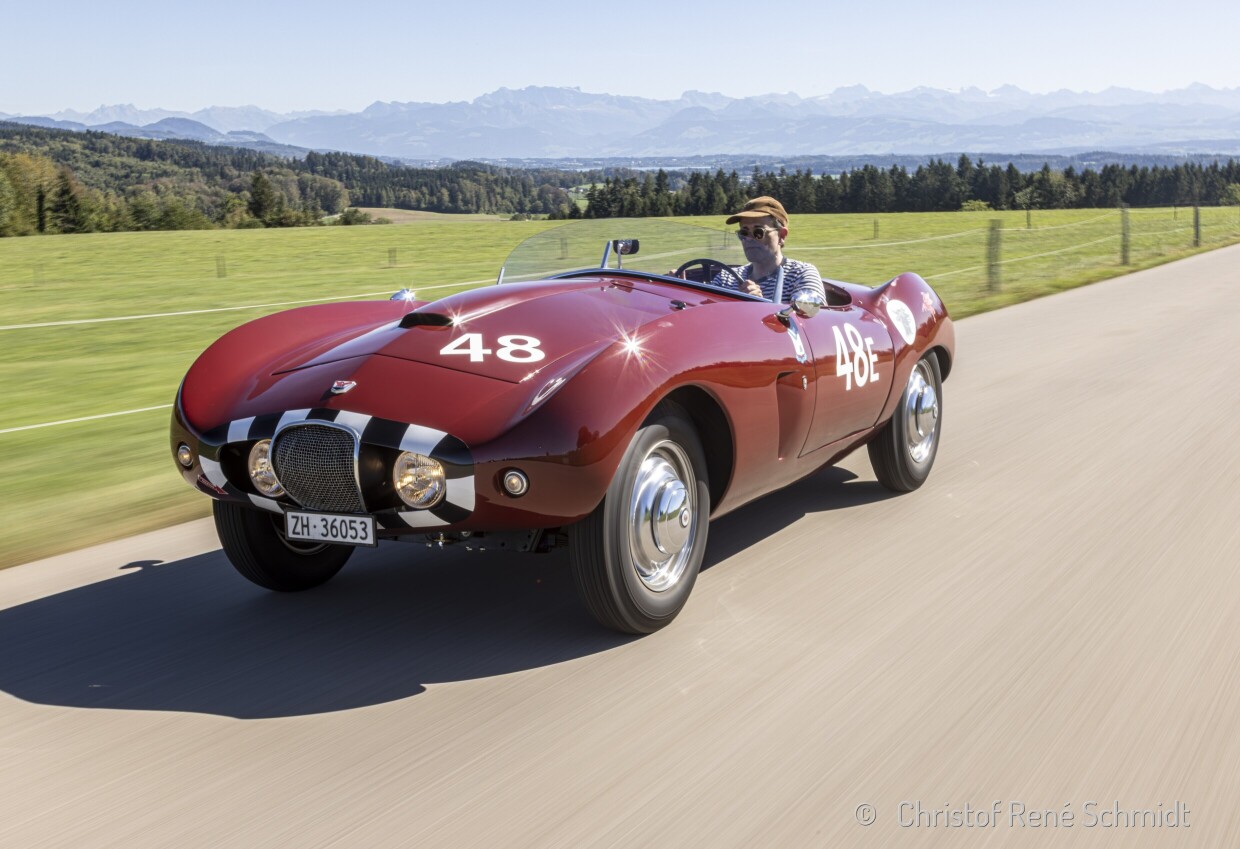
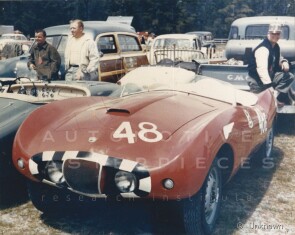
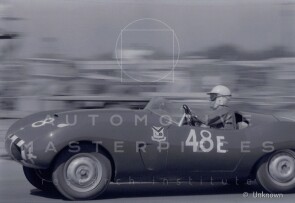
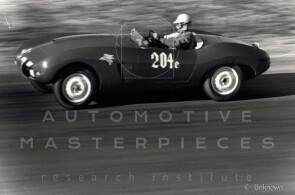
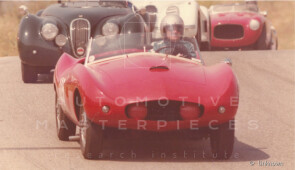
Early example: 9th of 142. Raced in California from new, winner at Buchanan Field. Featured in "The Devil’s Hairpin" and "James Dean: Race with Destiny" movies.
Why am I an Automotive Masterpiece?
A. Concept and show cars
B. Prototypes
C. One-off models
D. Remaining cars from extremely limited production runs
E. Historic event cars
F. Cars owned by famous people
G. Team cars
H. Works cars
I. Press cars
J. Movie cars
K. Famous chassis’ cars
L. Limited edition cars
J. Movie cars
Featured in "The Devil’s Hairpin" and "James Dean: Race with Destiny".
L. Limited edition cars
no. 142 manufactured, 9th built. 9th of 142 Arnolt Bristol and one of 85 Arnolt Bristol Competition/Bolide
In the years following the Second World War, several American automotive importers established marques of their own, under which specially commissioned European cars could be marketed through their existing distribution networks. One of the most enterprising figures in this field was Stanley H. “Wacky” Arnolt, an American industrialist and automobile importer who developed a particularly fruitful relationship with Carrozzeria Bertone. Following the commercial success of the Bertone-bodied Arnolt-MGs, Arnolt approached the Turin coachbuilder in 1953 with a more ambitious project. His intention was to create a lightweight sports car equally suited to road use and competition, based on the short-wheelbase chassis of the Bristol 404 and powered by Bristol’s two-litre six-cylinder engine. The Arnolt-Bristol was considerably more powerful than the contemporary Bristol touring models. It was fitted with a tuned version of Bristol’s Type BS1 engine, an advanced 1,971 cc straight-six whose origins could be traced back to the celebrated pre-war BMW 328. Equipped with three Solex carburettors, it produced approximately 130 bhp, compared with the 105 bhp commonly quoted for Bristol’s contemporary road-car engines. The four-speed gearbox and braking system were derived from those of the earlier Bristol 403. Nuccio Bertone entrusted the design to Franco Scaglione, then one of the most talented members of the Turin coachbuilder’s design team. The considerable height of the Bristol engine presented Scaglione with a difficult challenge, as the bonnet had to rise unusually high (given the considerable height of the engine) for such a compact open sports car. He responded with an ingenious exercise in visual balance: the strongly modelled front and rear wings, pronounced waistline and flowing lateral surfaces drew the eye away from the elevated centre section of the bonnet. The result was one of Scaglione’s most distinctive designs, combining dramatic proportions with a remarkably effective aerodynamic form. The new roadster attracted considerable attention when it was presented at the London Motor Show in October 1953 and was subsequently displayed in the United States, at the New York Motor Show in February 1954, where it was intended to find most of its customers. Bristol supplied the powered chassis from England, after which they were sent by rail to Bertone in Turin for the construction of the bodywork and interior. The completed cars were then shipped to the United States, where Arnolt’s organisation carried out final preparation and fitted any additional equipment requested by the customer. Because the cars were built largely by hand and in relatively small numbers, individual examples often display minor differences resulting from production development, competition requirements or customer specifications. Nevertheless, four principal configurations are generally recognised. The Competition was the most austere version, conceived primarily for racing and fitted with a small aeroscreen and minimal equipment. The Bolide retained the essentially competition-oriented character of the original car but offered a larger windscreen, a rudimentary folding soft top and slightly more practical road equipment. The DeLuxe was more comprehensively finished, with Connolly leather upholstery, improved weather protection, bumpers, side screens and additional interior appointments. A very small number of coupés was also produced, distinguished by enclosed bodywork and retractable headlamps. Approximately 142 Arnolt-Bristols were completed between 1954 and 1961. Traditionally published figures divide production into 85 Competition and Bolide roadsters, 54 DeLuxe roadsters and three DeLuxe coupés, although later research based on the Bristol Owners’ Club register has suggested that as many as six coupés may have been built, as some examples sold directly in Europe may not have appeared in S. H. Arnolt’s American sales records. Competition played an important role in the promotion of the model. The Arnolt-Bristols entered in races remained fundamentally similar to the road cars, although individual owners and mechanics introduced tuning and modifications according to their particular requirements. Their combination of light weight, robust Bristol engineering and effective aerodynamics made them especially competitive in the two-litre sports-car category. The model’s most celebrated early result came at the 12 Hours of Sebring on 13 March 1955. On their first factory-team appearance at the Florida endurance race, Arnolt-Bristols finished first, second and fourth in the Sports 2000 class, securing both a commanding class victory and the Team Trophy. Further notable results at Sebring followed, helping to establish the Arnolt-Bristol as one of the most successful Anglo-Italian-American sports cars of its period.
Chassis no. 404/X/3008, traditionally identified as the ninth Arnolt-Bristol built, was completed in Bolide specification and fitted with Bristol BS1 Mk II engine no. 203. Finished in red with a black interior, it was one of the examples that entered competition while still nearly new, beginning a remarkably long and varied sporting career that extended from contemporary SCCA racing in California to historic competition in the United States, New Zealand and Europe. Its earliest documented appearances date from the 1956 Californian sports-car season, when it was owned and driven by G. Scott Baxter and normally carried race number 48, achieving very good results. The best was obtained in July 1956 at the Buchanan Field Sports Car Races, where Baxter drove the field’s only Arnolt-Bristol. The result confirmed that the lightweight Bertone-bodied Bristol could compete successfully not only within its two-litre class but also against a broader field of production sports cars. By November 1956, chassis no. 404/X/3008 had passed to racing driver Don Hulette and was racing under number 204 up to the opening months of 1957, mainly at Pomona and at the Paramount Ranch, in California. The car’s association with Paramount Ranch also gave it an unusual connection with the cinema. Racing sequences for the 1957 motor-racing drama The Devil’s Hairpin were filmed at the Californian circuit during a race weekend, when Don Hulette was the car’s owner and driver. Chassis 404/X/3008 took part in the production and also appeared prominently on promotional material for the film. The car passed to new owners: James Oliver from 1958 to 1965 and Bob Keen from 1965 to 1979, but no details of their use of the car are presently available. In early 1979, 404/X/3008 was discovered in a Pasadena repair shop by Bill Watkins, an American engineer, racing driver and long-standing Arnolt-Bristol enthusiast. Watkins initially wondered whether it might be his former car, chassis 404/X/3006, which he had raced in period, but immediately recognised that 3008 was a Bolide rather than the more austere Competition model. The red car was street-legal, properly licensed and offered for sale at approximately twice its original new price. Watkins purchased it a few days later and began using it both as everyday transportation and on the winding mountain roads north of his home. Only a few weeks after purchasing the car, Watkins discovered historic racing through a Historic Motor Sports Association display at the Los Angeles County Fair. He entered the Arnolt-Bristol in the HMSA meeting at Riverside Raceway in April 1979. At that time, historic-racing preparation remained minimal. In 1981, following engine troubles caused by failure of the original-type BS1 crankshaft, Watkins replaced it with a stronger, counterbalanced D2-type “big-nose” crankshaft fitted with a viscous damper, eliminating the recurring torsional-vibration problem that affected the lighter BS1 component. The 1982 season proved successful and Watkins continued to race 3008 regularly through 1987, consistently finishing. During this period he was competing in approximately ten events each year, mainly with the Arnolt-Bristol. In February 1998, Watkins selected 3008 for the month-long Southern Festival of Speed in New Zealand because it remained road-legal and could be driven on public highways between events. Four decades after its role in The Devil’s Hairpin, 404/X/3008 returned to the screen in the 1997 television film James Dean: Race with Destiny. The racing sequences were filmed at Willow Springs Raceway, and Watkins appeared with actor Casper Van Dien, who played James Dean. In total, Watkins raced 404/X/3008 during 28 weekends at circuits throughout California before temporarily retiring it in favour of his third Arnolt-Bristol, chassis 404/X/3014. He nevertheless continued to return 3008 to service when its road-going versatility made it particularly suitable. In 1999, after approximately twenty years of ownership, Watkins sold 3008 to Wayne Hanson of San Diego, who continued its historic-racing career. Karl Gnadinger followed, as owner, from 2003 to 2004 and the car eventually passed to Dutch collector Ivo Noteboom, who had acquired it in Switzerland. Noteboom used 3008 in historic events and entered it under its traditional number 48 in the Peter Collins Trophy at the 81st Goodwood Members’ Meeting in April 2024. He later also acquired chassis 404/X/3006, reuniting the two Arnolt-Bristols most closely associated with Bill Watkins: the Competition model Watkins raced in period and the Bolide with which he returned to racing in 1979. In March 2026, chassis no. 404/X/3008 passed from Ivo Noteboom to Collezione Il Maneggio, a private Swiss collection.