
Researches
& updates
& updates
Ongoing
1953 O.S.C.A. MT4-2AD 1450
NEW FEATURE
Chassis no.
1127
Engine no.
1403
Coachbuilder
Frua
Beacon
ON/OFF
ON/OFF
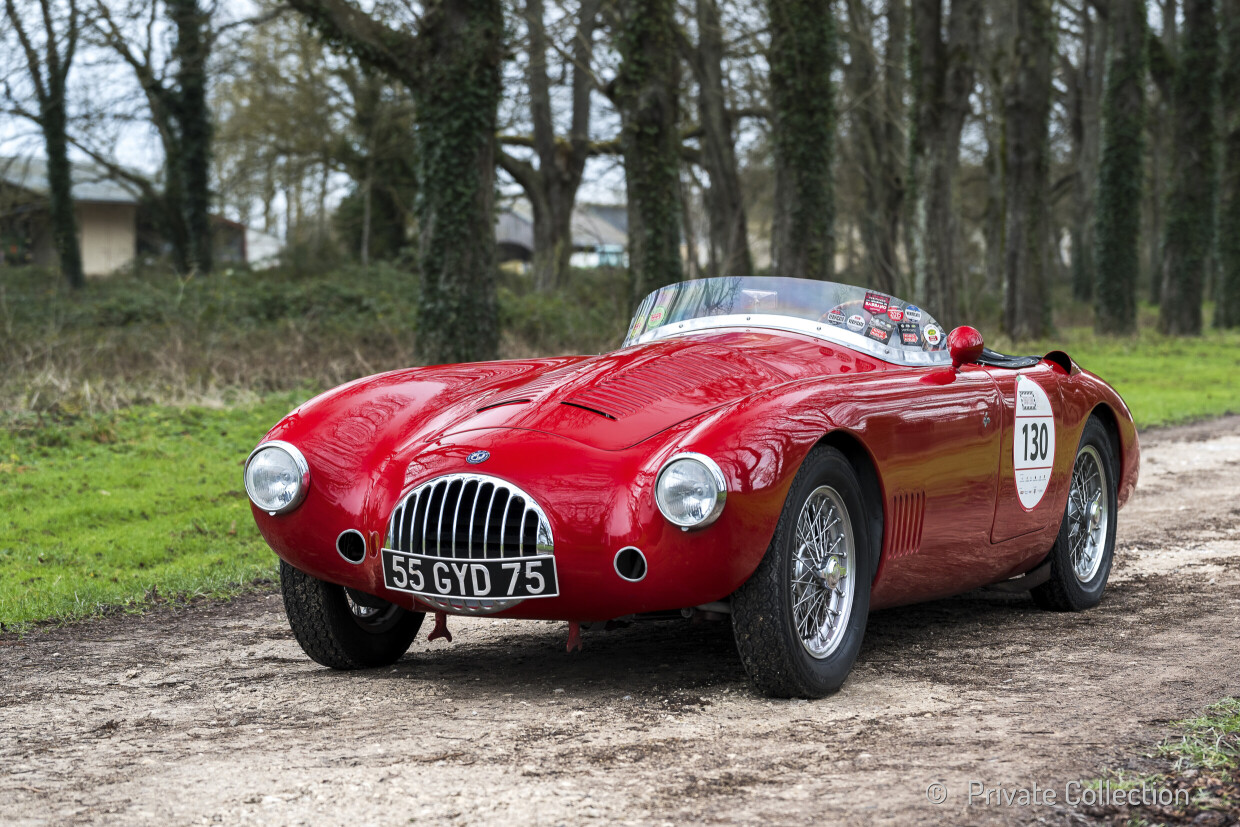
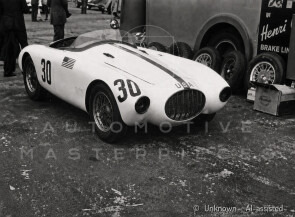
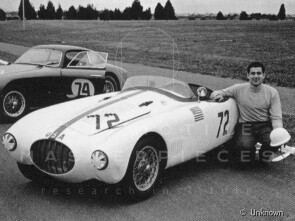
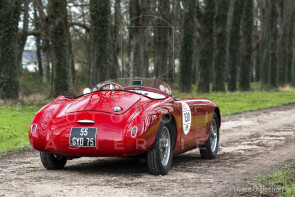
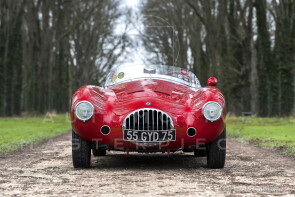
One of the few O.S.C.A. MT4-2ADs bodied by Frua. Raced by George Moffett, winner at Bergstrom and Watkins Glen, with a distinctive American competition history.
Why am I an Automotive Masterpiece?
A. Concept and show cars
B. Prototypes
C. One-off models
D. Remaining cars from extremely limited production runs
E. Historic event cars
F. Cars owned by famous people
G. Team cars
H. Works cars
I. Press cars
J. Movie cars
K. Famous chassis’ cars
L. Limited edition cars
L. Limited edition cars
no. 5 manufactured, 1st built
In 1937, following a period of financial difficulty, Ettore, Ernesto and Bindo Maserati sold the company bearing their family name to the industrialist Adolfo Orsi. Under the terms of the agreement, the brothers remained with Maserati for a further ten years, continuing to contribute their considerable technical experience to the Modena manufacturer. Once this contractual commitment had expired, they returned to San Lazzaro di Savena, near Bologna, where in 1947 they founded Officine Specializzate Costruzione Automobili, better known as O.S.C.A. The new company was established to produce lightweight competition cars in limited numbers. Without the financial resources of a major manufacturer, the Maserati brothers concentrated on small-displacement sports cars whose performance would depend upon low weight, mechanical refinement and handling rather than outright power. Their first model was the MT4, its designation standing for Maserati Tipo 4 cilindri. Introduced in 1948, the MT4 was initially conceived for the 1,100 cc racing category. Its construction reflected the brothers’ extensive competition experience and retained some of the principles employed in the Maserati A6GCS, one of the last cars developed during their time at Maserati. The MT4 featured a lightweight tubular chassis, independent front suspension by unequal-length wishbones and a live rear axle. Its compact four-cylinder engine was developed from Fiat-based origins, while the open two-seater bodywork followed the essential barchetta format required of a purpose-built sports-racing car. The MT4 first appeared in competition during the 1948 season. Following an early outing at the Coppa Acerbo at Pescara, Luigi Villoresi drove the new O.S.C.A. to victory at the Grand Prix of Naples. This immediate success demonstrated the effectiveness of the brothers’ approach and marked the beginning of an exceptional competition career. Giulio Cabianca was among the first private drivers to recognise the car’s potential and contributed to a growing series of victories that established O.S.C.A. as a formidable presence in the smaller-capacity classes. Throughout the first half of the 1950s, the MT4 was continuously developed. Engine capacity increased and increasingly sophisticated cylinder heads were introduced, while the chassis and bodywork were adapted to suit different circuits, categories and customer requirements. The original single-overhead-camshaft engine was followed by the twin-cam MT4-2AD, and successive versions competed with capacities ranging from approximately 1.1 to 1.5 litres. In its ultimate form, the engine displaced 1,491 cc and was equipped with twin ignition. The combination of modest dimensions, low weight and highly developed mechanical components made the MT4 one of the most effective sports-racing cars of its generation. Its greatest international achievement came at the 1954 12 Hours of Sebring, where the 1.5-litre MT4 entered by Briggs Cunningham and driven by Stirling Moss and Bill Lloyd won the race outright, defeating numerous larger and more powerful cars. Most MT4s were built as open two-seaters, with many receiving lightweight aluminium coachwork by Morelli of Ferrara. Other chassis were clothed by specialist coachbuilders including Frua and Vignale, which also produced a small number of berlinettas and individual interpretations. As was common among actively raced cars of the period, several MT4s were subsequently modified, re-engined or rebodied in order to remain competitive in changing racing categories. Produced in relatively small numbers between 1948 and the mid-1950s, the MT4 became O.S.C.A.’s most numerous and successful model. It established the technical principles and competitive reputation upon which the company built its subsequent range of sports cars and single-seaters, powered by four-, six- and twelve-cylinder engines of widely differing capacities.
The most significant development of the MT4 was the adoption of a new twin-overhead-camshaft cylinder head, identified by the suffix 2AD, standing for “due alberi di distribuzione”. This solution replaced the single-overhead-camshaft arrangement of the original MT4 and considerably improved the breathing and performance of O.S.C.A.’s compact four-cylinder engine. The MT4-2AD retained the light and straightforward construction of the original model but introduced an engine featuring an all-aluminum cylinder block and DOHC cylinder head. Fed by twin Weber carburettors, it combined high specific output with the flexibility required for sports-car racing, where the same basic design could be adapted to different capacity classes. The 2AD engine first appeared in 1,092 cc form and was progressively developed through changes to its bore and stroke. Variants of 1,342 cc and 1,453 cc were produced, followed by an ultimate version of approximately 1.5 litres. Power outputs differed according to displacement, compression ratio, carburettor specification and the requirements of individual customers. The later engines also benefited from further refinements, including twin-spark ignition on certain 1,500 cc versions. Rather than representing a single fixed specification, the MT4-2AD designation therefore identified a developing family of closely related sports-racing cars. Engines could be rebuilt or enlarged during their competition careers, while chassis were frequently updated and fitted with new or modified bodywork. Consequently, the specification recorded for an individual MT4-2AD at a particular date may not correspond either to its original configuration or to that in which it survives today. The MT4 adaptability enabled the model to remain competitive for several seasons and established O.S.C.A. as one of the leading constructors of small-displacement sports-racing cars during the 1950s.
Chassis no. 1127 was completed in 1953 as an MT4-2AD with open two-seater coachwork attributed to Frua. It belongs to the small group of early envelope-bodied MT4s associated with the Turin coachbuilder, alongside a limited number of other examples such as chassis nos. 1129, 1133 and 1135. Registry information suggests that chassis no. 1127 may originally have been fitted with a small-capacity 1.1-litre engine, although period race entries from 1953 indicate that it was already competing in 1,342 cc form, and by late 1953 it was being advertised as a 1,342 cc car. On 25 February 1953 it was acquired by George Moffett, the American sportsman, racing driver, yachtsman, nature photographer and conservationist. Moffett entered the O.S.C.A. for the 12 Hours of Sebring in March, but the car did not appear. Its first confirmed competition outing came the following month at Bergstrom Air Force Base, Texas, where Moffett crashed heavily during Saturday practice, striking the concrete base of an airfield light and overturning the car. He suffered fractures to an arm and a leg and was unable to race. Despite extensive damage to the body around the driver's compartment, the main structure was found to be sound. Boris “Bob” Said and a group of mechanics and personnel from Bergstrom Air Force Base worked through the night to repair the car, including rebuilding the damaged bodywork and checking the running gear. Originally white, the O.S.C.A. was hastily repainted bright red and christened the “B.A.F.B. Special” — Bergstrom Air Force Base Special — with the name painted across the bonnet. On 12 April, Said drove the repaired car in both races, winning the 100-mile event outright and taking the class victory. Moffett subsequently campaigned chassis 1127 extensively during the 1953 season. He finished ninth overall and second in class at Floyd Bennett Field in August, competed at Thompson and Stout Field, and on 19 September won the Queen Catherine Cup at Watkins Glen after a closely fought race with Henry Wessells III in another O.S.C.A. The two cars dominated the event, with Moffett eventually winning by 1 minute 37.4 seconds. Further appearances followed at Thompson, where he won Race 8 in October, and at the Sowega races held at Turner Air Force Base. Photographic comparison has proved particularly useful in separating chassis 1127 from another contemporary MT4, chassis 1121, whose competition history was long partly confused with that of Moffett's car. Period images consistently associated with 1127 show a distinctive configuration including U.S. flags on the front wings. The early envelope-bodied MT4s were individually built and several closely related cars have subsequently been confused in race records and photographs. Chassis no. 1121, the 1952 “muletto” and precursor of the later body style, had a single door on the right-hand side and was successively raced by Bill Spear, Bill David and Chick Leson. Chassis no. 1127 followed a separate history with George Moffett and can be distinguished by its two doors, nine-bar grille, two rows of seventeen bonnet louvers and asymmetric side vents — six on the left and five on the right. Among the closely related cars, chassis no. 1124 was another 1,350 cc MT4 with Frua bodywork and the same two rows of seventeen bonnet louvers seen on 1127. Chassis no. 1129 was supplied to Briggs Cunningham and later developed with larger-capacity engines, while no. 1133, also attributed to Frua, is documented in period photographs carrying Frua script on its body. No. 1135 was a 1,450 cc Frua-bodied car acquired by Bill David, and no. 1137 became Cunningham’s principal MT4, winning the 1954 Sebring 12 Hours with Stirling Moss and Bill Lloyd. Chassis no. 1139, another 1,450 cc car, was delivered in January 1954 specifically “for George Moffett”, further complicating later attributions of some of his race appearances. The distinctive combination of features of chassis no. 1127 can be recognised in photographs from Floyd Bennett, Watkins Glen and, subsequently, Buenos Aires. In January 1954 Moffett and Said took the O.S.C.A. to Argentina for the Buenos Aires 1000 Kilometres. Entered as no. 72, the car retired after five laps with gearbox trouble. Contemporary American reports identify Moffett as the entrant, although some later sources name Jack Frierson, and this detail remains unresolved. The Buenos Aires race is the last competition appearance presently established for chassis 1127 in this period. The subsequent history of the car is less completely documented. It also remains to be clarified when the original engine was replaced by the car’s current 1,450 cc unit, a change that probably occurred towards the end of its active competition career. It eventually passed to Illinois-based collector, dealer and historian Tim Ritter, a specialist in small-displacement Italian sports and racing cars. In 1984 Ritter agreed to sell chassis nos. 1127 and 1122 to Ananda Covindassamy through R.S. Classics of Belleville, Illinois; the purchase of 1127 was formally completed with final payment on 26 January 1985. Covindassamy later confirmed that Ritter could no longer recall from whom he had acquired the car. Covindassamy retained chassis 1127 for more than forty years. After unsuccessful earlier attempts in Britain and France, a complete restoration was carried out by Blakeney Motor Sport near London between 1997 and 2003, with subsequent mechanical work by Autofficina Aldo. From 2004 the O.S.C.A. returned to regular use in major historic events, taking part repeatedly in the Mille Miglia between 2004 and 2017, as well as the Leggenda di Bassano and the Targa Florio Classica in 2019. Research into some aspects of chassis no. 1127 remains in progress.