
Researches
& updates
& updates
Ongoing
1955 H.W.M. Jaguar
NEW FEATURE
Chassis no.
52 106
Engine no.
E2008-9
Coachbuilder
H.W.M.
Beacon
ON/OFF
ON/OFF
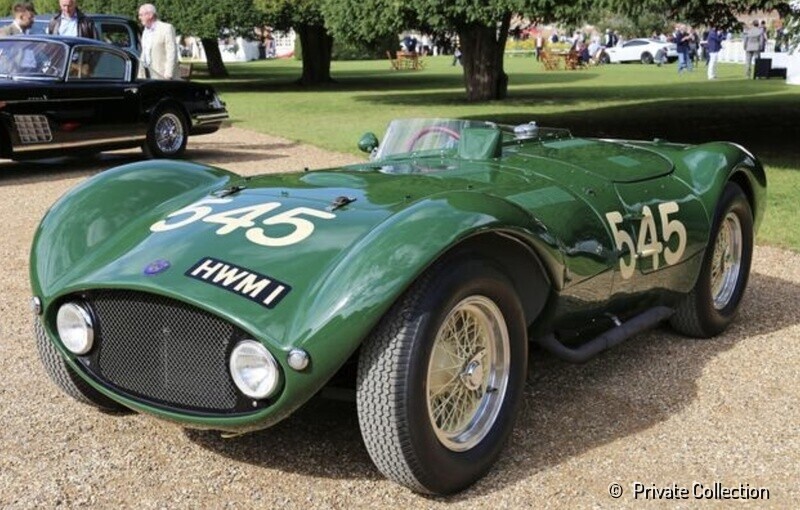
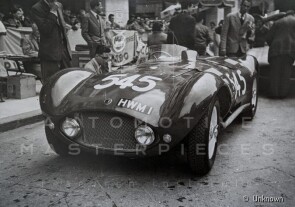
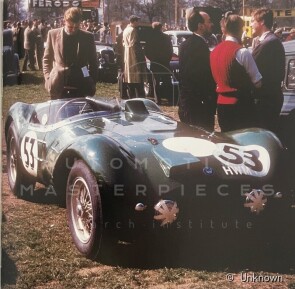
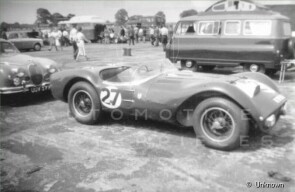
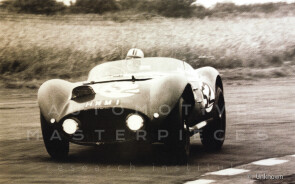
One of a kind. Jaguar D-type spec engine. Works car. Mille Miglia 1956 entry, multiple British wins, later campaigned by Alan Mann. Long historic racing career.
Why am I an Automotive Masterpiece?
A. Concept and show cars
B. Prototypes
C. One-off models
D. Remaining cars from extremely limited production runs
E. Historic event cars
F. Cars owned by famous people
G. Team cars
H. Works cars
I. Press cars
J. Movie cars
K. Famous chassis’ cars
L. Limited edition cars
H.W.M., an abbreviation of Hersham and Walton Motors, took its name from the Surrey locations of Hersham and Walton-on-Thames, where John Heath had established and expanded his motor business. After the Second World War, Heath joined forces with racing driver George Abecassis, combining their commercial and competition activities under H.W. Motors Ltd., the garage and motor business they operated in Surrey. Abecassis brought his experience as a successful racing driver and businessman, while Heath increasingly concentrated on the technical and engineering side of the operation. Their first competition activities centred on Alta machinery. In 1947 they acquired a pre-war Grand Prix Alta, and during the following years Heath progressively developed cars of increasingly independent design. By 1948 H.W. Motors had produced a sports car specifically for competition use, while the following season saw the construction of a new tubular chassis which marked a further step towards H.W.M. becoming a constructor in its own right rather than simply modifying existing cars. This development coincided with the emergence of Formula Two as an important international category. From 1950 H.W.M. became a regular presence in British and Continental racing, operating on a comparatively modest scale but gaining a reputation for light, simple and effective cars. The team provided opportunities to a remarkable group of drivers, among them Stirling Moss, Lance Macklin, Peter Collins, Paul Frère and Louis Chiron, while Abecassis himself continued to compete. H.W.M.’s intensive racing programme, achieved with relatively limited resources, established the small Surrey concern as one of the characteristic British constructors of the early post-war period. The connection with Jaguar engines began independently of the works team. In 1952 Oscar Moore installed a 3.4-litre Jaguar XK120 engine in an H.W.M., adapting the chassis and transmission to accommodate the larger unit. The conversion demonstrated the suitability of Jaguar’s powerful six-cylinder engine to the light H.W.M. chassis and anticipated the direction subsequently taken by the factory itself.
Following Oscar Moore’s private conversion, H.W.M. began developing its own Jaguar-engined sports-racing cars. During 1953 George Abecassis acquired an H.W.M.-Alta sports car from Phil Scragg, removed its existing body and adapted the chassis to accept a Jaguar XK engine. The resulting car, registered HWM 1, became the first works H.W.M.-Jaguar. Its lightweight construction combined with the power of the Jaguar six-cylinder engine proved particularly effective, while continued development brought changes to the engine, transmission and bodywork as the car was used extensively in British and Continental competition. The first HWM 1 retained much of H.W.M.’s earlier single-seater engineering, with independent front suspension and a De Dion rear axle, while the Jaguar engine was coupled to a modified gearbox and transmission. In competition the car demonstrated considerable speed but also reflected H.W.M.’s characteristically empirical development process: mechanical failures, repairs and modifications followed one another as Heath and Abecassis refined the concept through racing. The car was entered in events ranging from British hill climbs and circuit races to major Continental meetings and the Mille Miglia. By the end of 1954, sports-car racing had become increasingly important to H.W.M. The company initially considered a new car around Coventry Climax’s proposed 2½-litre “Godiva” V8, but the engine did not become available for competition. Instead, the proven Jaguar XK unit remained the natural choice. Further Jaguar-engined cars followed, including machines constructed for Tony Gaze and Geoff Mansell, combining surviving H.W.M. racing chassis and suspension components with wider sports-car bodies. These cars formed an evolutionary bridge between the original HWM 1 and the purpose-designed H.W.M.-Jaguars that followed. For 1955 H.W.M. developed a substantially new generation of sports-racing car. The chassis was designed by Eugene Dunn specifically for sports-car use rather than being adapted from an earlier Formula Two frame. Dunn retained H.W.M.’s characteristic twin main chassis tubes, but angled them inward at the front and rear and outward around the cockpit, producing what has been described as a “kite-shaped” tubular structure. The arrangement provided greater space for longer front wishbones and a more sophisticated suspension layout. At the front, double wishbones worked with coil-spring and damper units, while the rear retained a one-piece De Dion tube with coil springs and a central vertical sliding location. A Salisbury Powr-Lok differential replaced the earlier quick-change arrangement, while very large Alfin drum brakes filled the available space inside the wheels. George Abecassis designed a new body, replacing the simpler slab-sided appearance of the earlier cars with a lower and more flowing form. Two closely related works cars were built to this new concept. The first was registered XPE 2 and appeared during the 1955 season, progressively developed in competition. Its Jaguar XK engine was equipped with a D-Type cylinder head, while revisions to cooling, suspension and steering accompanied its continuing use. The car became one of H.W.M.’s principal works entries, driven by Abecassis and other leading drivers. A second car was subsequently completed to the same basic concept. Although based on Dunn’s same angled-tube chassis principle, the second car incorporated significant detail revisions, particularly at the front, where longer coil/damper units passed through the upper wishbones and located on tall suspension turrets.
Chassis no. 52/106 was this second Series Two H.W.M.-Jaguar. Designed by Eugene Dunn, its tubular structure was conceived specifically for sports-car competition and differed fundamentally from the earlier Jaguar-engined H.W.M.s derived from previous racing chassis. Abecassis also revised the body compared with XPE 2. The trailing edges of the front wheel arches were given an oval form to help extract hot air from the brakes, while the front and rear wings terminated in sharper, almost razor-edged profiles, an idea influenced by Frank Feeley’s styling of the Aston Martin DB3S. The right-hand side of the cockpit was more conventional than that of XPE 2, the radiator grille was enlarged in response to concerns over the heat generated by the full-race Jaguar engines, and the headlights were mounted low in the grille. The small rectangular carburettor air intake then used on XPE 2 was initially omitted. Although chassis 52/106 is recorded as a 1955 manufacture, the evidence assembled during the research indicates that completion extended into early 1956. The car initially used Jaguar XK engine N1858-8, fitted with a D-Type-specification or D-Type-derived cylinder head, while registration HWM 1, previously used on an earlier works H.W.M.-Jaguar, was transferred to the new car. In its original configuration, chassis 52/106 had unpainted bare-metal bodywork and a compact windscreen surrounding the driver only. Its first identified competition appearance was at Snetterton on 25 March 1956, where George Abecassis finished second after leading most of the race. For the 1956 Mille Miglia the car was painted green and entered as no. 545 for John Heath. In severe rain near Ravenna, Heath crashed heavily and died from his injuries two days later. The damaged car was returned to Walton and underwent an extensive reconstruction lasting approximately four months. Evidence found by Paul Grist during a much later restoration suggested that the original chassis was retained, although the front ends of the chassis rails had been cut away and replacement sections sleeved into place. The rebuilt body incorporated a revised front section and a wider wraparound windscreen extending across both seats. The car returned to action at the beginning of September 1956, when Noël Cunningham-Reid drove it at the Brighton Speed Trials as a shakedown before its return to circuit racing. Some months after the rebuild, a small rectangular intake similar to that used on XPE 2 was added above the main grille to feed the carburettor cold-air box, later developing into a more pronounced scoop. HWM 1 continued as a works H.W.M. throughout 1956 and 1957, driven by Noël Cunningham-Reid, Dick Protheroe, Duncan Hamilton, Peter Blond, Jack Fairman and other leading British competitors. Among its principal results was an outright victory at Snetterton in October 1956. At the end of 1957 George Abecassis offered both Series Two cars for sale. John Bekaert, one of the enthusiasts associated with Speedwell Stable, tried both cars at Brands Hatch and selected HWM 1, paying £1,500 and becoming its first private owner. Following an overhaul at Speedwell Garage, Bekaert raced the car extensively during 1958. According to the contemporary H.W.M. history, his season produced ten victories, three second places, four thirds and four Best Times of Day in sprint events, making 1958 one of the most successful seasons in the car’s competition career. According to the later H.W.M. history, before his racing campaign was fully under way a front stub axle broke during testing at Goodwood, causing a heavy accident in which Bekaert broke his collar bone and the front of the car was badly damaged. For 1959 Bekaert moved on to a Lister-Jaguar, while his friend Dick Milne subsequently raced HWM 1. At the B.A.R.C. Members’ Meeting that opened the 1959 season at Goodwood on 14 March, the car – described by Autosport as the “ex-John Bekaert” H.W.M.-Jaguar – lost a wheel and stub axle in morning practice and was unable to race. Period reports variously identify the driver as R. Milne or R. M. Milne, and the precise ownership status during this period remains uncertain. The car nevertheless continued to achieve strong results, including outright victories at Silverstone. Around 1960, chassis no. 52/106 was acquired for £700 by Alan Mann, then running Wayside Garage with Roy Pierpoint. Mann raced the car for approximately two seasons, achieving several strong results including an outright victory at Silverstone and Best Time of Day performances in speed events. He later recalled the H.W.M. as a good but demanding car, particularly because of the movement of fuel in its large unbaffled tank. Finding the drum brakes inadequate, Mann also fabricated two circular ducts outboard of the headlights to direct cooling air onto the front brakes. During this period the H.W.M. was documented with its engine capacity increased from 3.4 to 3.8 litres. The car was fitted with Jaguar engine E2008-9, originally used in 3.4-litre form in Ecurie Ecosse Jaguar D-Type XKD 501 during 1955 and subsequently converted to 3,781 cc, although the precise date of its installation in chassis 52/106 remains unclear. In 1962, as Mann increasingly concentrated on professional team management, he traded chassis no. 52/106 against a Jaguar XK140 road car. By 1963 the H.W.M. was being offered for sale by London dealer Danny Margulies for £645. It subsequently passed through Hugh Hall and Harry Fellowes before reaching Paul Gardner, who completely rebuilt what had by then become a very tired car. At some stage during this period the H.W.M. had also been repaired after an accident with a different nose and grille and headlights mounted on drooping front wings. Gardner was followed by international sports-car racer Richard Bond, who retained the car until October 1974. Bond sold chassis no. 52/106 to Julian Kirkland “Kirk” Rylands for £5,500. At the time the car was painted silver and its front bodywork had been altered into a rough approximation of XPE 2’s form. Rylands retained it for 34 years and used it extensively in historic racing, rallies and road events. Initially dissatisfied with its handling, he worked with Arthur Mallock to reposition the steering rack correctly, align the rear radius rods and increase the negative camber of the front wheels, changes which substantially transformed the car’s behaviour. In 2008, chassis no. 52/106 passed to Paul Grist, who undertook a comprehensive restoration, returning the front bodywork to its correct original configuration and repainting the car British Racing Green. Following completion of the work, Grist’s son Matt won the 2015 George Abecassis Trophy at Silverstone after starting from the back of the grid. Grist subsequently sold the car to Jim Cochrane and Mark Midgley, who continued to race it at Goodwood and other historic events. By early 2019 the car was being offered for sale through London historic-car specialist Gregor Fisken. Gregor Fisken subsequently became associated with the car as owner and driver. Under his ownership, chassis no. 52/106 underwent a further comprehensive mechanical restoration and development programme and was returned to its 1956 Mille Miglia specification and livery. Fisken raced it in major historic events, while the car also appeared at the Goodwood Festival of Speed, Silverstone and the Concours of Elegance at Hampton Court Palace. Since 2023 chassis 52/106 has been recorded in a private collection and has continued to appear in the Mille Miglia, driven by Daniel Schlatter in 2023, 2025 and 2026.