Researches
& updates
& updates
Ongoing
1984 Ferrari Testarossa
Chassis no.
*ZFFTA17B000053285*
Engine no.
F113*00008*
Coachbuilder
Pininfarina
Beacon
ON/OFF
ON/OFF
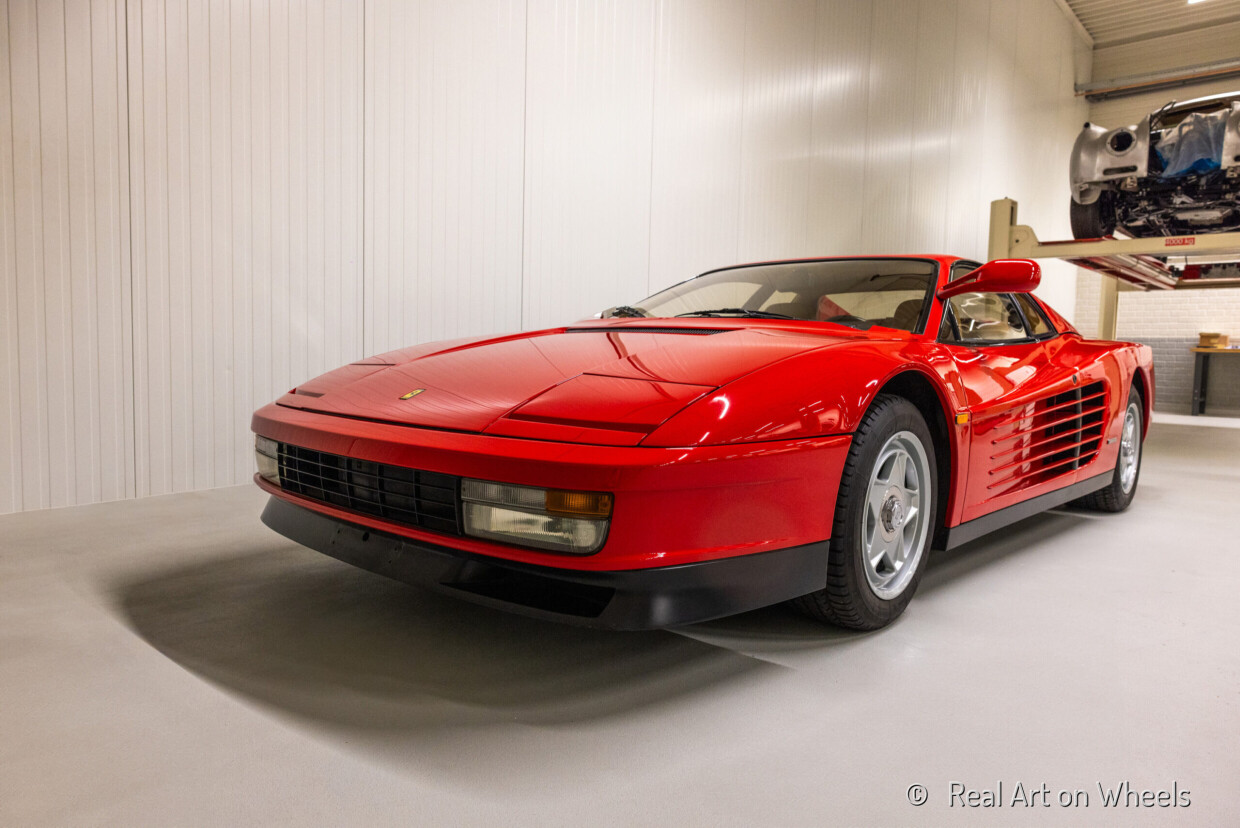
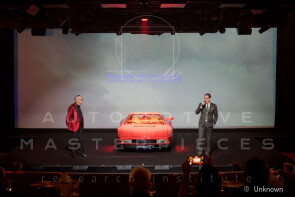
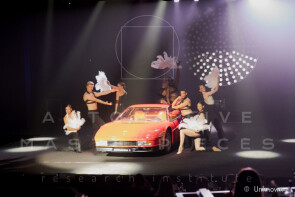
3rd of possibly 10 pre-production Pininfarina, of which only 4 used as show cars. Official launch car in Paris. Turin Motor Show. First Ferrari with TRX system.
Why am I an Automotive Masterpiece?
A. Concept and show cars
B. Prototypes
C. One-off models
D. Remaining cars from extremely limited production runs
E. Historic event cars
F. Cars owned by famous people
G. Team cars
H. Works cars
I. Press cars
J. Movie cars
K. Famous chassis’ cars
L. Limited edition cars
L. Limited edition cars
no. 10 manufactured, 3rd built. The pre-series Pininfarinas were probably fewer than ten units, all numbered in block 53000–53300, built between January and July 1984. Chassis no. 53285 is believed to be the third known Testarossa built — following the earliest pre-production examples 53081 and 53283.
The Testarossa was the first twelve-cylinder Ferrari born from an increasingly modern and collaborative process, yet it remained the last berlinetta to bear the direct imprint of Enzo Ferrari’s will. Officially unveiled at the Paris Motor Show in October 1984, the Ferrari Testarossa marked one of the most iconic moments in the history of the marque and of Pininfarina. Designed by Leonardo Fioravanti, the car was conceived as the direct heir to the 512 BBi, from which it retained the mid-rear flat-twelve layout, but reinterpreted in a completely new key to meet the technical and stylistic demands of the decade. The name “Testarossa,” a tribute to the one used by Ferrari in the 1950s for its sports barchettas, referred to the red-painted cam covers of its 4,942-cc flat-twelve engine, fed by Bosch K-Jetronic mechanical fuel injection and equipped with dry-sump lubrication. With 390 horsepower and a top speed exceeding 290 km/h, the new berlinetta offered leading-edge performance combined with unprecedented usability for a Ferrari 12-cylinder: improved cabin space, effective air-conditioning, and greater overall refinement. The chassis, a new tubular steel frame, was longer and wider than that of the BBi, with increased track widths for better stability and weight distribution. The innovative architecture of the side air intakes — which became the stylistic signature of an entire era — was the result of a precise functional need: to channel air toward the radiators, relocated to the sides to free the front luggage compartment and to improve thermal comfort in the cockpit. Those horizontal slats — the famous “grilles” — transformed a technical requirement into a design motif that would become emblematic of the 1980s. The body, made of steel and aluminum with lightweight alloy front lid and rear deck, was built by Pininfarina, which managed to balance the car’s aggressiveness with elegant proportions and refined surfaces. Its width — over 1.97 meters — was remarkable, yet perfectly harmonious in the overall view. Inside, the symmetrical dashboard, the more relaxed driving position, and the attention to detail marked a decisive step forward in Ferrari’s build quality. Production began in 1985 and, up to 1986, the Testarossa retained its distinctive single high-mounted left mirror, hence the nickname “Monospecchio.” From 1987 onward, two lower side mirrors were adopted, and in 1988 the central wheel nut gave way to five-bolt wheels. Despite these updates, the general design remained unchanged for more than a decade, a testament to the strength and timelessness of the original styling. More than 7,000 units were built between 1984 and 1991 — an absolute record for a mid-engined Ferrari 12-cylinder. In 1992 the Testarossa was succeeded by the 512 TR, deeply updated yet faithful to the same concept, followed in 1994 by the F512 M, the final evolution of the celebrated flat-twelve engine. A true icon of style and power, the Testarossa quickly became a symbol of popular culture: featured in films, posters and television series — most notably Miami Vice — it embodied the image of Ferrari in the 1980s, exuberant, technological and instantly recognizable. Still today, it remains one of the most representative models of the partnership between Pininfarina design and Ferrari engineering — the perfect synthesis of functionality and automotive sculpture.
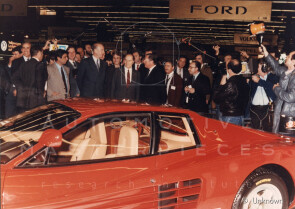
Presented for the first time to the public in 1984, Ferrari Testarossa chassis no. ZFFTA17B000053285 is believed to be the car displayed by Pininfarina at the 71st Paris Motor Show, opened on 4 October 1984. A period photograph captures the car being presented by Sergio Pininfarina to French President François Mitterrand. This example represents one of the very first Testarossa built, and possibly the first to feature Michelin TRX tyre and wheel system, which would soon become the standard equipment for the production cars. In its proportions and details, this Testarossa shows all the defining features of the earliest “Monospecchio” production series: the single high-mounted left mirror, the star-shaped alloy wheels with central wheel nut, the wide black rear grille concealing the tail-lamps, and the two-tone cockpit with black dashboard and beige leather upholstery. As for all pre-production cars completed by Pininfarina, any differences from later production — in materials, fittings or componentry — are subtle and not visible to the naked eye, since the car was already built to full show standard for public presentation. The only visible distinction lies in minor details: the pre-production cars featured “provisional” rectangular side indicators, mounted just behind the front wheel arch, while production models adopted smaller rounded amber units integrated flush with the bodywork. Also, in the rear script: on the earliest display cars the “testarossa” badge was positioned lower and finished in satin silver, while later production examples adopted a raised chrome emblem placed slightly higher on the tail panel — a subtle change reflecting the transition from prototype to full production. It should be noted that chassis no. 53285 does not belong to the earlier group of about thirty mechanical prototypes built by ITCA between 1982 and 1983, which were used for development and crash testing. Instead, it is part of the following batch of pre-production cars completed by Pininfarina in early 1984 — a very small series of fewer than ten fully finished examples, all bearing regular Ferrari chassis numbers. Among these cars, all numbered in the 53000–53300 range and built between January and July 1984, four are known to have served as show and validation vehicles ahead of full production, with chassis no. 53283 and no. 53285 representing the model’s official debut at the 1984 Paris Motor Show. The production specification statement issued by Pininfarina in September 2024 reports that, according to factory records, the chassis and mechanical components of car no. 53285 were supplied by Ferrari to Pininfarina on 9 May 1984 to be completed with bodywork and interior trim, and that the car left the Pininfarina facilities on 31 July 1984. The example was described as finished in exterior colour “Rosso Ferrari”, with “Naturale” leather interior and “Castoro” carpets. No further notes were specified. Chassis no. 53285 is believed to be the third known Testarossa built — following the earliest pre-production examples, chassis no. 53081 and 53283, and can be considered the “institutional” launch car, prepared by Pininfarina for the official debut at the Paris Motor Show in a red livery, of course. Another near-identical early Testarossa was simultaneously used for the gala evening at the Lido de Paris on 3 October and later appeared in the Charles Pozzi showroom and at the Brussels Motor Show in January 1985, both events associated with Ferrari’s commercial presentation network. After the closing of the Paris Motor Show, chassis no. 53285 continued its career, being displayed at the Salone dell’Automobile di Torino (14–25 November 1984). It was later shipped to Germany, where no records of its use are known; it is possible that it was displayed at the Essen Motor Show, although its participation has not been confirmed. Following its European engagements, chassis no. 53285 was shipped to Japan ahead of its Tokyo commitments — reportedly, though not confirmed, the earliest Testarossa to reach Asia. Whether this car actually appeared at the 26th Tokyo Motor Show in autumn 1985 remains uncertain; if so, it would have represented Ferrari in three major international markets. What is certain is that the car was consigned in Japan to the official importer and dealer Cornes & Co. Ltd and was later acquired by celebrated racing driver Sokichi Shikiba. According to Ferrari’s certification, the car — originally exhibited in the iconic Rosso Corsa at the international motor shows — was repainted in those same days in an unusual Metallic Brown shade. The car remained in Japan for nearly four decades, residing in a private collection from 2002 until its rediscovery in the spring of 2024. Imported into the Netherlands, it then received a comprehensive service at Real Art on Wheels while preserving its fully original, numbers-matching condition. A Pininfarina Certification was finalized in September 2024, and the car was road-registered in the Netherlands. In October 2024 it returned to Paris in its pristine "Rosso Corsa" livery as the centerpiece of the “40 Years of Ferrari Testarossa” celebration at the Théâtre du Lido.