
Researches
& updates
& updates
Ongoing
1972 Alfa Romeo Tipo 33/TT/3
NEW FEATURE
Chassis no.
AR 115 72*003*
Engine no.
*030*0092*
Coachbuilder
Autodelta
Beacon
ON/OFF
ON/OFF
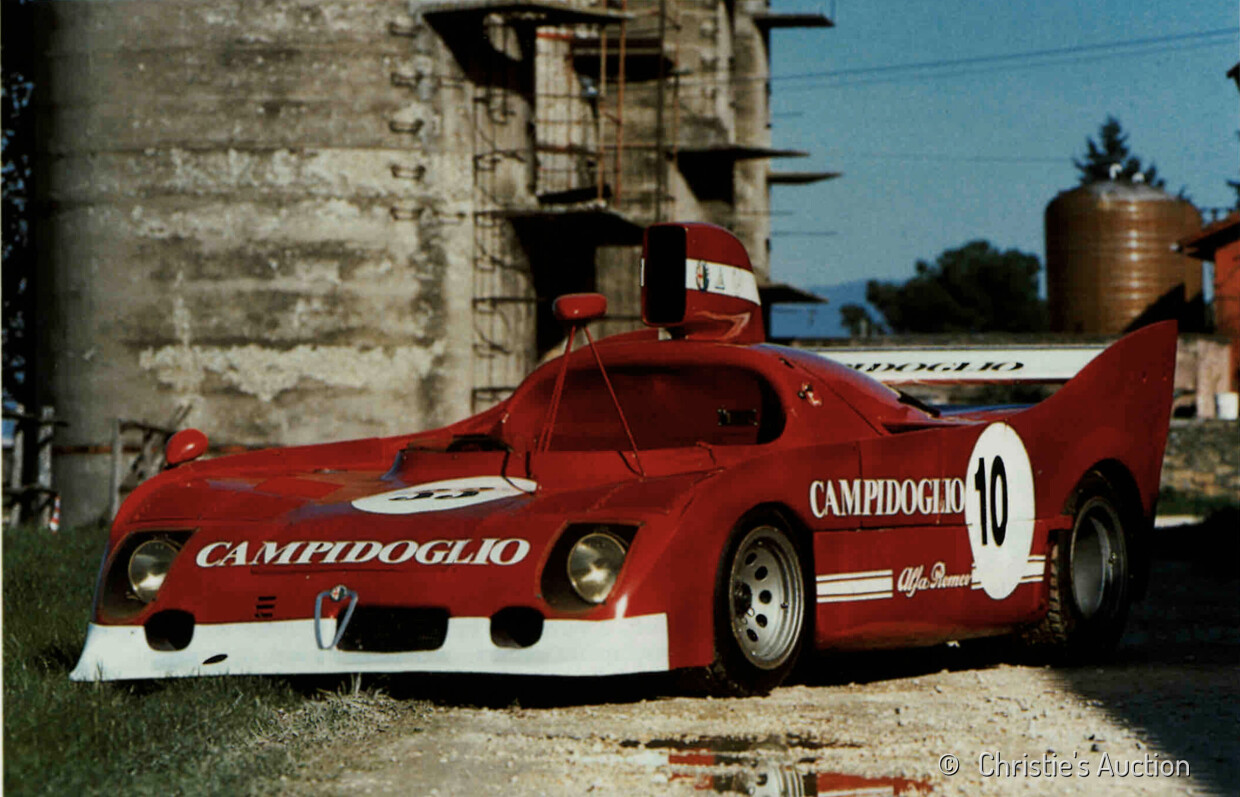
Autodelta works car. 1972 WSC, 4th at Le Mans before retiring. Long Italian career followed: multiple victories and often podiums. Body updated to TT12 in 1975.
Why am I an Automotive Masterpiece?
A. Concept and show cars
B. Prototypes
C. One-off models
D. Remaining cars from extremely limited production runs
E. Historic event cars
F. Cars owned by famous people
G. Team cars
H. Works cars
I. Press cars
J. Movie cars
K. Famous chassis’ cars
L. Limited edition cars
L. Limited edition cars
no. 12 manufactured, 3rd built. A total of twelve Alfa Romeo 33 TT 3 chassis are generally recognized and identified through contemporary documentation and later research.
The Alfa Romeo Tipo 33 was a racing car produced from 1967 to 1977, created primarily to compete in the World Sportscar Championship and later also in the Can-Am series and in hillclimb racing. In 1967, the Alfa Romeo 33 Stradale was introduced, a road-going version derived directly from the racing prototype and considered one of the most beautiful sports cars ever built. The Tipo 33 and its derivatives achieved major success, winning two editions of the World Sportscar Championship, in 1975 and 1977, the latter with a dominant season in which Alfa Romeo won every race on the calendar. Alfa Romeo had officially withdrawn from motor racing in 1951, after securing the Formula 1 World Championship with the Tipo 159 Alfetta, and only resumed racing activities more than a decade later. Rather than returning to single-seater competition, Alfa Romeo decided to focus on closed-wheel categories, which at the time enjoyed strong popularity thanks to the World Sportscar Championship and the prestigious European Hillclimb Championship. For this purpose, a specially developed car was needed: a pure sports prototype, distinctly different from earlier Gran Turismo models such as the TZ. By the will of Alfa Romeo’s then-president Giuseppe Luraghi, the “105.33 project” was launched in the autumn of 1964. The number “105” referred to the internal code for the Alfa Romeo Giulia and its derivatives, while “33” was personally chosen by Luraghi to identify and distinguish the new prototype series. In the spring of 1965, the first prototype of the Tipo 33, designed at Alfa Romeo, was delivered to Autodelta—then still based in Udine—for development and racing preparation. Autodelta, under the direction of engineer Carlo Chiti, played a decisive role in the evolution of the car and in the management of Alfa Romeo’s racing activities throughout the decade. From a technical point of view, the first Tipo 33 was an advanced design for its time: it featured a lightweight tubular spaceframe chassis made of aluminium, with a central monocoque section, and it was powered by a compact 2-litre V8 engine developing around 270 hp. Over the following years, the project evolved through successive versions—33/2, 33/3, T33/4, 33TT12, and 33SC12—each representing a step forward in terms of engine capacity, power output, and aerodynamics. Alongside these main variants, special configurations were also developed, such as a long-tail version and the Mugello Spider, derived from the early “periscope” model. The Tipo 33 thus became the symbol of Alfa Romeo’s return to international racing, and its legacy is linked not only to the Stradale, but also to famous drivers such as Nino Vaccarella, Andrea De Adamich, Toine Hezemans, and Arturo Merzario, who brought the cars to victory on circuits and mountain roads across Europe.
For the 1972 season Alfa Romeo introduced the 33 TT3, the designation “TT” standing for Telaio Tubolare (tubular chassis), which replaced the previous design with a stronger and more rigid structure. The TT3 was powered by a 3-litre V8 engine derived from the earlier 2-litre unit but thoroughly revised, capable of producing around 440 hp. The combination of the new chassis and the more powerful engine made the TT3 more competitive against rivals such as Ferrari, Porsche, and Matra in the World Sportscar Championship. The 33 TT3 made its debut at the opening round of the 1972 season and quickly proved its potential. The car scored notable results including overall victories at the 1972 1000 km of Spa, where Nino Vaccarella and Andrea De Adamich drove to success, and at the Targa Florio, won by the duo of Arturo Merzario and Sandro Munari. These triumphs marked the return of Alfa Romeo to the very top of endurance racing after the promising but class-focused 33/2 years. Although it was sometimes hampered by reliability issues and strong competition, the TT3 laid the groundwork for the further development of the Alfa Romeo prototypes, leading to the 33 TT12 and later the dominant 33 SC12. With its victories on some of the most demanding circuits and roads in the world, the TT3 confirmed the effectiveness of the tubular chassis and established Alfa Romeo as a serious contender in the 3-litre prototype category.
1972 Alfa Romeo 33 TT 3, chassis no. 115.72.003, was built as a factory Autodelta entry: during the 1972 season the car was fielded directly by Autodelta in World Sportscar Championship. According to official Automobile Club de l’Ouest (ACO) records, chassis no. 115.72.003 was entered at the 1972 24 Hours of Le Mans as car no. 17, driven by Vic Elford and Helmut Marko (third driver registered was Toine Hezemans). The car ran strongly, reaching fourth place overall before retiring in the 19th hour due to transmission failure. Earlier sources had associated this chassis with car no. 18 (Stommelen/Hezemans/Galli), but ACO documentation confirms that 003 was car no. 17. It is highly likely that the car’s participation in the 1972 season was not limited to the, albeit extremely prestigious, Le Mans race; however, the events that various sources have traditionally attributed to it (the 1000 km of Buenos Aires, the Targa Florio, and the 1000 km of Brands Hatch) are still awaiting secure validation. In 1973 the car continued to appear in competition, driven on several occasions by Autodelta test driver Teodoro Zeccoli. In 1974 it was sold to Italian driver Bruno Ottomano. Under his ownership the car was campaigned extensively in Italian hillclimbs, achieving numerous overall victories and class wins and, beyond its factory career, chassis 115.72.003 is believed to have contested a wide number of Italian national races between 1974 and 1977, mostly in hillclimbs and endurance events. Between 1974 and 1975 racing seasons, Ottomano had Autodelta rebody the car with TT12-style bodywork while retaining the original 3-litre V8 engine. Among the results confirmed by contemporary sources are the 1974 Targa Florio in 1974, the 500 km Imola (9th overall) and Coppa Florio in 1976, the 500 km Monza, 400 km Vallelunga (10th overall), Coppa Florio, and 250 km Imola in 1977. This competition record makes chassis 115.72.003 one of the best-documented and most active examples of the 33 TT 3, with a history that bridges both the factory Autodelta era and an extensive privateer career in Italy. According to the RIAR certificate, the car was acquired in 1978 by collector Fabrizio Violati, while the sales notes from Christie’s auction house indicate that a certain Mr. Palma purchased it in 1978 and resold it the following year to the next long-term owner, who kept it for some twenty years. In any case, the car remained largely unrestored, occasionally used, and was officially recognized by the Registro Italiano Alfa Romeo. The car later appeared at auction at Christie’s, Geneva, on 18 May 1998 (“Important Collectors’ Motor Cars & Related Automobilia”) and sold for an important amount.