
Researches
& updates
& updates
Ongoing
1969 Ferrari 365 GTB/4
Chassis no.
*12653*
Engine no.
12653
Coachbuilder
Pininfarina/Carrozzeria Scaglietti
Beacon
ON/OFF
ON/OFF
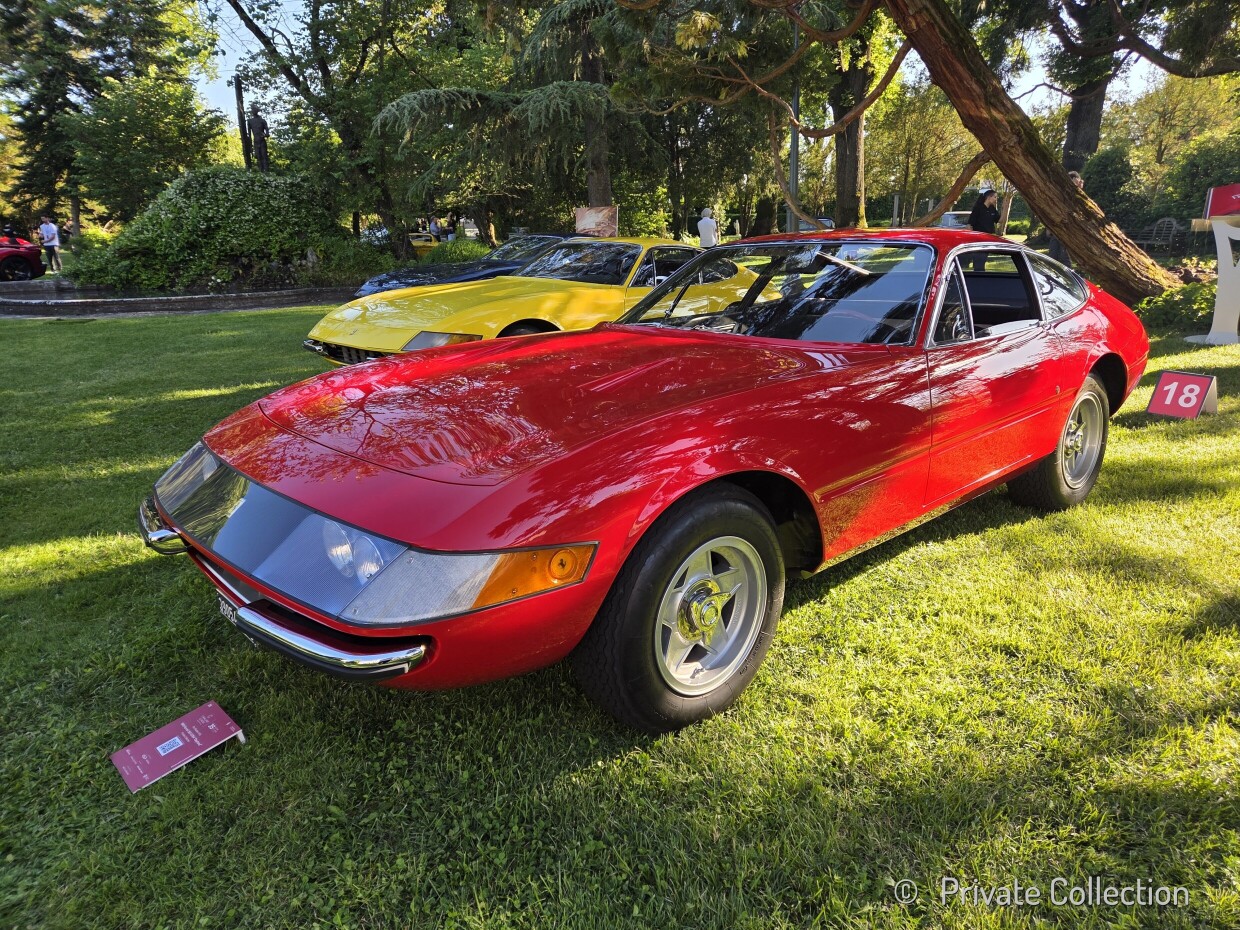
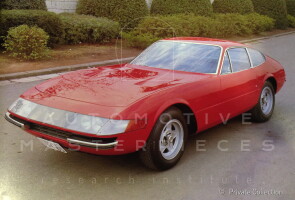
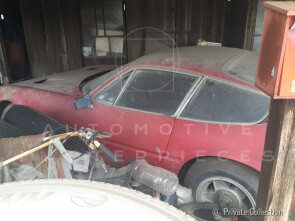
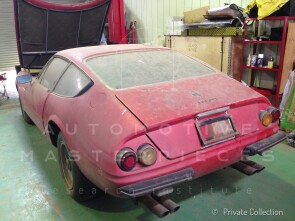
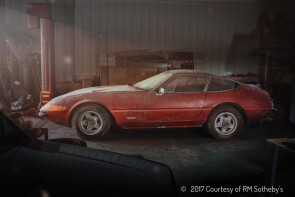
An almost unique Daytona. One of only two alloy bodied, the sole for road-use. Famous owners. Hidden 40 years in Japan, rediscovered as a time-capsule barn find.
Why am I an Automotive Masterpiece?
A. Concept and show cars
B. Prototypes
C. One-off models
D. Remaining cars from extremely limited production runs
E. Historic event cars
F. Cars owned by famous people
G. Team cars
H. Works cars
I. Press cars
J. Movie cars
K. Famous chassis’ cars
L. Limited edition cars
L. Limited edition cars
no. 2 manufactured, 2nd built
Introduced at the Paris Motor Show in the autumn of 1968, the Ferrari 365 GTB/4 represented the most accomplished evolution of the great front-engined Ferrari berlinetta of the 1960s. Intended to take up the legacy of the 275 GTB/4, it developed its technical concept into a more powerful, modern and mature form, while retaining the classic architecture of the Maranello grand tourer: front-mounted V12 engine, two seats, extremely high performance and a layout conceived to cover long distances at high speed. The model’s official name was 365 GTB/4, but the car soon became universally known as the “Daytona”, an unofficial designation attributed to it by the press in reference to Ferrari’s historic one-two-three finish at the 24 Hours of Daytona in 1967. The nickname ultimately became established in collective memory, although it was not part of the original nomenclature used by the factory. The body, designed by Leonardo Fioravanti for Pininfarina and built by Scaglietti, marked a clear evolution from Ferrari’s earlier styling tradition. The low, sharp front end, long bonnet, set-back cabin and compact tail gave the 365 GTB/4 a taut and contemporary appearance, combining elegance and aggression without sacrificing its unmistakable Ferrari identity. The earliest examples featured the distinctive covered headlights set behind a transparent front panel, a solution later replaced, chiefly for regulatory reasons connected with the United States market, by retractable headlights. From a technical standpoint, the Daytona was powered by the 4,390 cc Tipo 251 V12, an evolution of the Colombo engine family, fed by six twin-choke Weber carburettors. The valve gear used four overhead camshafts, two per bank, as indicated by the “/4” suffix. Power output, commonly quoted at 352 hp, allowed the car to reach maximum speeds in the region of 280 km/h, placing it among the fastest road cars of its era. The five-speed manual gearbox was mounted at the rear according to the transaxle layout, a solution that helped improve weight distribution and dynamic balance. The tubular chassis, independent wishbone suspension, disc brakes on all four wheels and refined mechanical layout made it an extremely fast car, but also a solid, usable and relatively comfortable one by the standards of high-performance Ferraris of the period. The 365 GTB/4 was in fact conceived primarily as a road-going grand tourer rather than as a competition car, yet its technical potential also made possible an important sporting career in the hands of private entrants and racing teams. Between 1971 and 1973, the 365 GTB/4 Competizione versions were developed, lightened and prepared for racing use. Although they were not entered directly by Scuderia Ferrari as a front-line works programme, these cars achieved highly significant results in endurance racing, including class victories at the 24 Hours of Le Mans in 1972, 1973 and 1974. These successes confirmed the strength and effectiveness of the Daytona’s technical basis, which remained competitive even at a time when sports cars were rapidly evolving towards mid-engined layouts. Production of the 365 GTB/4 berlinetta continued until 1973, with approximately 1,284 examples built. The closed version was joined by the rarer 365 GTS/4 spider version, largely destined for the American market. The Daytona family marked the end of a fundamental cycle in Ferrari history: that of the great front-engined V12 berlinettas of the classical tradition, before the arrival of the mid-rear-engined 365 GT4 Berlinetta Boxer.
The Berlinetta Ferrari 365 GTB/4, chassis no. *12653*, was completed on 19 June 1969, in its early left-hand-drive European-specification, with Plexiglas-covered headlights and power windows. It is an example of exceptional significance, being one of only two Daytona built with a fully aluminum body by Carrozzeria Scaglietti, and the only one intended for road use; the other being chassis no. 12547, commissioned by Luigi Chinetti to run the 24 Hours of Le Mans. Factory data identify it with extreme precision, with chassis type 605, engine type 251, internal engine no. B 18, transaxle type 605, internal no. N 32, assembly sequence no. 46 and Scaglietti body no. 32; originally finished in Rosso Chiaro 20-R-190 with Nero VM 8500 leather interior. The car’s early history is closely connected with important Italian Ferrari circles. Its certificate of origin was issued on 13 September 1969, and it was delivered new through Motor S.p.A. di Carla Allegretti e C. of Bologna. It was registered on Bologna plates BO 390540 and sold shortly afterwards to Poligrafici Il Borgo di Luciano Conti e C. S.a.S. A close friend of Enzo Ferrari, Luciano Conti was a versatile entrepreneur and a prominent figure on the Italian motorsport scene. A sports car driver in the 1960s, he later became the publisher of popular Italian sports magazines such as Autosprint, Motosprint and Guerin Sportivo. Under his ownership, Autosprint became Italy’s leading motor racing weekly, also featuring regular columns by Enzo Ferrari himself. He also founded Conti Editore, the publishing house that issued several books by Enzo Ferrari. At the time he owned the Daytona — which may have been built with its aluminum-body specification at his request — he was also President of the Automobile Club of Bologna and one of the promoters of the Imola circuit. In September 1970 chassis no. *12653* passed to Guido Maran of Verona, and a month later to Carlo Ferruzzi of Ravenna, under whom it was later registered on Ravenna plates RA 163100. Carlo Ferruzzi added another distinctive chapter to the early Italian history of chassis no. 12653. A nephew of Serafino Ferruzzi, founder of the Ferruzzi Group, he belonged to one of Italy’s most important agri-food and industrial families. The group grew into a true business empire, with interests spanning agriculture, industry and shipping, and was later led by Raoul Gardini after the founder’s death, while remaining strongly family-run until its financial crisis. Carlo Ferruzzi is not known to have held an active managerial role, but he was nevertheless a shareholder in companies belonging to the group. He was also closely connected with the nautical world, developing a reputation as a sailing photographer and following major regattas during the period. Sailing and racing yachts were, in fact, a true family passion within the wider Ferruzzi circle, later finding one of their most celebrated expressions in Raoul Gardini’s Il Moro di Venezia America’s Cup campaign. Carlo Ferruzzi was also an enthusiast gentleman driver but used the Daytona only for leisure. During its first Italian period, chassis no. 12653 was regularly used and maintained as evidenced by the service documentation, carried out at Ferrari’s Assistenza Clienti in Viale Trento Trieste, Modena, which also attests to the mileage, which in February 1971 was around 11,000 km travelled. On 12 July 1971 the Italian registration was cancelled, and the Daytona was exported to Japan later that year on behalf of Seaside Motor. In January 1972, chassis no. 12653 appeared in Car Graphic, in an issue remembered for bringing together three of the most important Italian supercars of the period: the Ferrari Daytona, Lamborghini Miura and Maserati Ghibli. The car then remained in Japan for more than four decades, passing in May 1975 to Goro Fuwa of Gifu, head of ABC Auto, a local motor trader, in April 1979 to Tateo Ito of Nagoya, and in March 1980 to Makoto Takai, who would become the car’s long-term Japanese custodian. Under his ownership, chassis no. 12653 disappeared from public view for nearly four decades, before its rediscovery. When inspected by the expert Marcel Massini in June 2017, it was still in largely unrestored, long-stored condition and showed 36,390 km, a reading considered consistent with its history. The inspection recorded the presence of its matching chassis and engine numbers and the aluminium bodywork. Although the car had received some later modifications, mainly due to Japanese law, and cosmetic alterations, the inspection also noted the impressive preservation of important components. The car was exported from Japan through D-Trading Company Limited and sold at RM Sotheby’s Ferrari – Leggenda e Passione auction in Maranello in September 2017, achieving €1,807,000. Chassis no. 12653 later enjoyed public visibility, including its unrestored presentation at Rétromobile in 2018 and its subsequent connection with the Ferrari Forever context in Modena. By 2025, the car was completing a restoration involving Bacchelli & Villa for the bodywork and Ferrari Classiche for mechanical, electrical, interior and final assembly work. Its debut appearance in fully restored condition took place at Cavallino Classic Modena in May 2026. The historicity and provenance of the Ferrari 365 GTB/4, chassis no. *12653* have been certified by RINA.