
Researches
& updates
& updates
Ongoing
1966 Bizzarrini GT Europa 1900
Chassis no.
B 507
Engine no.
T19S0000207R
Coachbuilder
Bizzarrini
Beacon
ON/OFF
ON/OFF
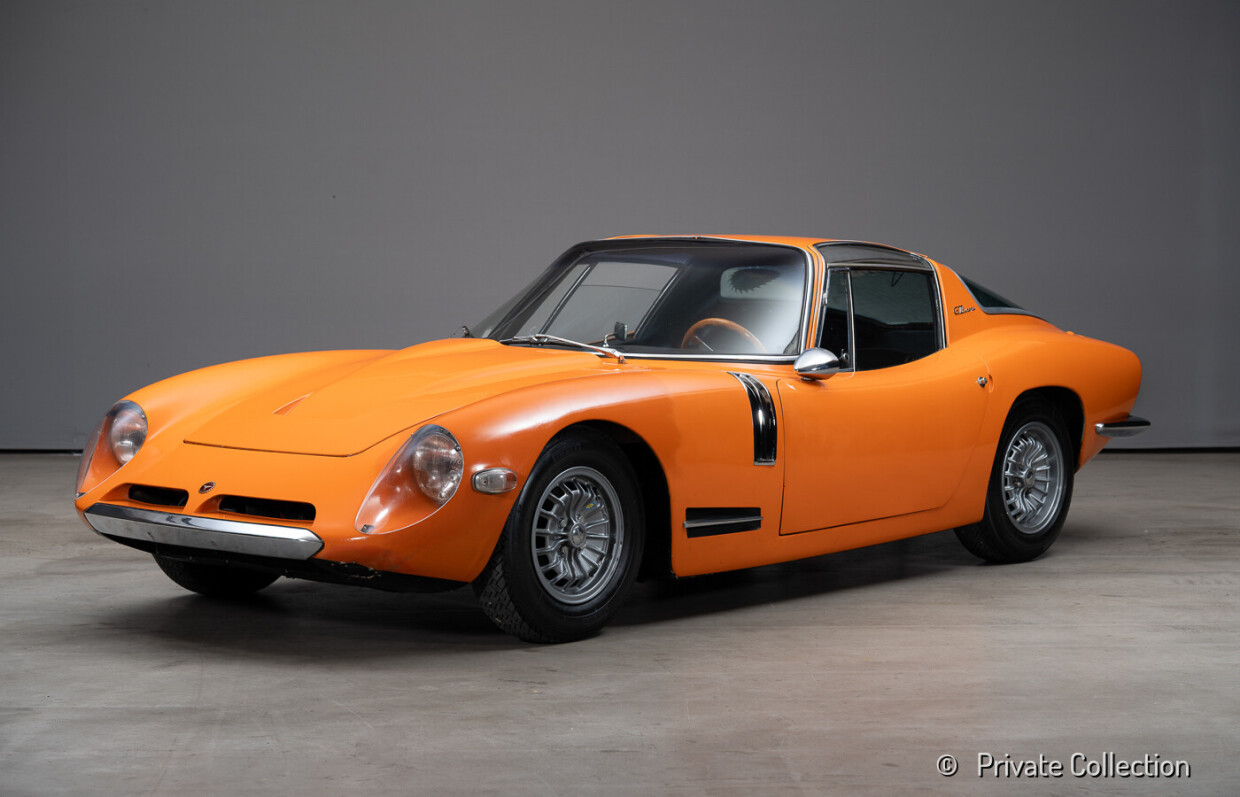
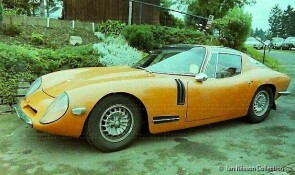
One of 3-4 original cars out of a total of 11 supposedly built. Used by Giotto Bizzarrini family. Long time in Sweden. Villa d'Este with expert owner Malte Fromm.
Why am I an Automotive Masterpiece?
A. Concept and show cars
B. Prototypes
C. One-off models
D. Remaining cars from extremely limited production runs
E. Historic event cars
F. Cars owned by famous people
G. Team cars
H. Works cars
I. Press cars
J. Movie cars
K. Famous chassis’ cars
L. Limited edition cars
L. Limited edition cars
no. 11 manufactured
The GT Europa 1900 was conceived in Giotto Bizzarrini’s Livorno workshop by second half of the 1960s as the ideal “little sister” of the 5300 GT, transferring into a gran turismo of more modest displacement and cost a significant part of the technical culture and conceptual approach typical of the marque, as declared in the presentation brochure of the model. The aim was not to create an inexpensive car in the strict sense, but rather a refined sporting automobile, accessible to a broader public than that of the company’s large gran turismo models, without renouncing a modern structure, advanced mechanical solutions, and a strong stylistic personality. The gestation of the model, begun as early as 1964, reflected the company’s industrial and financial difficulties. Presented at the Salone dell’Automobile in Torino in November 1966, the GT Europa succeeded in carving out a place for itself among both the media and the public, despite a context crowded with highly attractive new introductions. The aerodynamic line, developed in the “wind tunnel” of the University of Pisa, was set out by Pietro Vanni and appeared clean, balanced, and surprisingly modern. The door aperture of the GT Europa 1900 extended into the roofline, a solution that likely served both practical and stylistic purposes: easing access to the low-slung cabin while also contributing to the car’s light, airy greenhouse. In this respect, it can be seen as an interesting precursor, though not a direct equivalent, to the more radical roof-cut butterfly doors of the Alfa Romeo 33 Stradale introduced in 1967. Notable was the choice of the large rear window hinged at the roof, rather uncommon at the time, designed to facilitate access to the luggage compartment and destined to characterize the car’s identity. The designer Paolo Niccolai recalled that it was not easy to persuade Saint-Gobain to produce the glass for that rear window, because of its size and rather complex design. From a technical point of view, the initial idea of adopting the Fiat 1500 engine-gearbox unit was abandoned in favor of the short-stroke Opel unit; in the human association between the two brilliant men from Livorno, Bizzarrini and Lampredi, commercial relations with General Motors, established through the supply of V8 engines for the 5300 GT, ultimately prevailed. The 1.9-liter Opel OHV inline-4 was mounted in a front-mid position, paired with a four-speed ZF gearbox and a rear limited-slip differential. This was designed by an unexpected yet close partner of the engineer, Oto-Melara, which developed a unit capable of working within an innovative independent-suspension layout. The Campagnolo disc brakes operated on all four wheels through a dual-circuit system, with the rear brakes inboard; suspension was independent, with wishbones on both axles. The chassis combined boxed sheet metal and tubular molybdenum-steel elements, while the fiberglass body manufactured by Labron Plastic helped to keep weight down, featuring a differentiated structure and a safety roll bar integrated into the roof. The berlinetta was credited with about 110 hp, a top speed in the region of 200 km/h, and a weight distribution perfectly balanced between the two axles. Different tire sizes between front and rear optimized handling and the effective use of power. At its debut, all the specialized press gave it a favorable description, while Bizzarrini himself declared a competitive projected price of 2,480,000 lire. Yet, when the car entered the July 1967 price list of the monthly Quattroruote, was considerably higher: 2,980,000 lire. And this was due to the collapse of one of the company’s many development projects, in which the engineer had become entangled with unscrupulous shareholders and speculators. The fragile industrial balance of the marque prevented the GT Europa 1900 from becoming the production success its qualities would probably have deserved. While, at the same time, the very solid Opel was presenting its own “1900 GT” coupé, equipped with the same engine and achieving broad commercial success together with important victories on the international racing circuit, the number of Bizzarrini GT Europa 1900s built remained extremely small, presumably 11 examples completed (12, according to Giotto), to which other cars finished with the remaining material after the factory’s closure were added. Secondo Stefano Volpi erano state preparate 18 scocche ma di auto finite ne furono realizzate 3, massimo 4 prima del fallimento, per poi arrivare a 11 vetture concluse in tutto. It appears that the chassis numbers were not stamped at the time of construction and the plates were only applied later, generating confusion in the numbers and attributions. There were no substantial differences between one another, except for one detail: the air vents on the sides of the front fenders. On the 1966 Turin prototype they featured a horizontal grille with nine chrome elements. The same detail was confirmed in the model’s first brochure, in 1967. On the first production unit, the air outlets had the same dimensions but had no decorative element at all. At the 1967 Salone dell’Automobile in Torino, a light-colored 1900 was exhibited with an air outlet combined with a chrome element. This choice was repeated on other cars completed in that first period. Later, to the horizontal outlet a second vertical one was added, fitted with three chrome elements by the door shut line and recalled the one of the 5300 Strada. In one final case, the second vent was obtained from a slight swelling in the flanks and had no decoration. The extremely limited production, together with the detail differences among the individual examples, tells a story made up of brilliant intuitions, highly developed craftsmanship, and inevitable compromises.
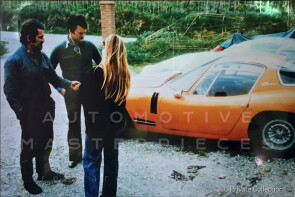
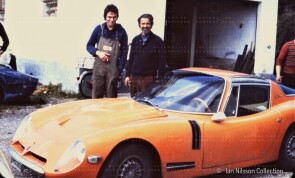
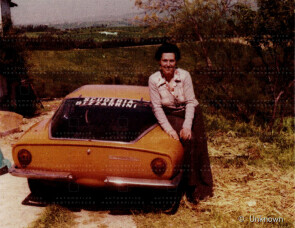
The Bizzarrini GT Europa 1900, chassis no. B 507, belongs to the first group of examples of this model built by Bizzarrini S.p.A. before the 1969 bankruptcy; the car displays indeed details that identify it as an example among the first produced, such as the large front/side indicator units on the front wings and the original chromed license-plate lights on the divided rear bumper. It results that it was not included among the assets of the bankruptcy proceedings. According to Ian Nilsson’s recollection: “I have seen some original cars, and they all had matching engine numbers. 0507 has engine no. 207R, 0511 has 211R, and 0505 has 0205R.” It is one of the supposed three examples finished in orange (perhaps referred to as “giallo medio”). Built in 1966 and initially registered to Bizzarrini S.p.A. itself, it does not appear to have been road-registered. At a later stage, around 1968, the car passed directly to Giotto Bizzarrini, remaining in his possession until June 1978. According to the testimony of Stefano Volpi, who was working for Giotto at the time, the car was used by the Bizzarrini family, including Giotto’s son Giuseppe. A photograph shows the car beside Rosanna Bizzarrini, Giotto’s wife. In June 1978, the Swedish enthusiast Ian Nilsson bought the car at the Bizzarrini family’s farm and workshop in Castelnuovo della Misericordia, in the province of Livorno. The car had no plates at that time, but it bore the “Scuderia Bizzarrini” script on the rear window, a designation created by Giotto himself after the bankruptcy. The possibility that it identified cars intended by the company for competition use remains to be verified, as does the possibility that this particular example had specifications described as “Corsa” or was prepared by Conrero. It appears that the car had covered 54,000 km by 1974 and that, at the time of purchase, Nilsson recorded a mileage of 60,000 km. Nilsson himself recalled that in 1976 he had bought the GT 5300 Strada, chassis no. 0307, from Giotto and that on that occasion he saw chassis no. B 507 for the first time. He made a down payment for it in 1977, collected it the following year, and drove it home. He recalled that he never saw any registration plate on it but noticed that Giotto used “PROVA” (i.e. test) plates. Both cars he bought carried the “SCUDERIA BIZZARRINI” script on the rear screen, and he supposed that they had been used as “team cars.” He used the GT Europa 1900 for trips to the Oldtimer Grand Prix at the Nürburgring with his wife and for other car meetings. The car was then garaged when he moved to France and, during this period, the rear screen mysteriously cracked into pieces, so he never drove it again. From 1979, chassis no. B 507 had been recorded as registered in Sweden with plate KCJ 456, and it was subsequently withdrawn from circulation in 1985. The car nevertheless remained in Sweden, with Nilsson, until 2012 and, in the meantime, began to enter the literature dedicated to the Bizzarrini marque, with significant bibliographic mentions, thus outlining a long period of almost static, yet not invisible, preservation. In 2012, the car passed to Malte Fromm, a leading figure in the Bizzarrini world, an expert on the marque and, for many years, holder of the Bizzarrini rights, having also acquired several assets from the bankruptcy, including the archive. Fromm retained the car’s original colour, but had its distinctive rear window restored, including the script. Under his ownership, the car experienced a particularly significant moment in its recent history: its participation in the Concorso d’Eleganza Villa d’Este, in Cernobbio, in May 2025, in the class “Frozen in Time: Preservation ‘Time Capsules’ from 1990-1973 which have survived in unrestored state,” driven by Fromm himself. Bearing an Italian “PROVA LI 88” plate, in its condition “in patina”. After the concours, chassis no. B 507 was offered for sale by Thiesen Hamburg GmbH and, in November 2025, the car had been acquired by Collezione Il Maneggio, in Switzerland.