
Researches
& updates
& updates
Ongoing
1955 Alfa Romeo Giulietta Spider
Chassis no.
AR1495*0004
Engine no.
131540182
Coachbuilder
Bertone
Beacon
ON/OFF
ON/OFF
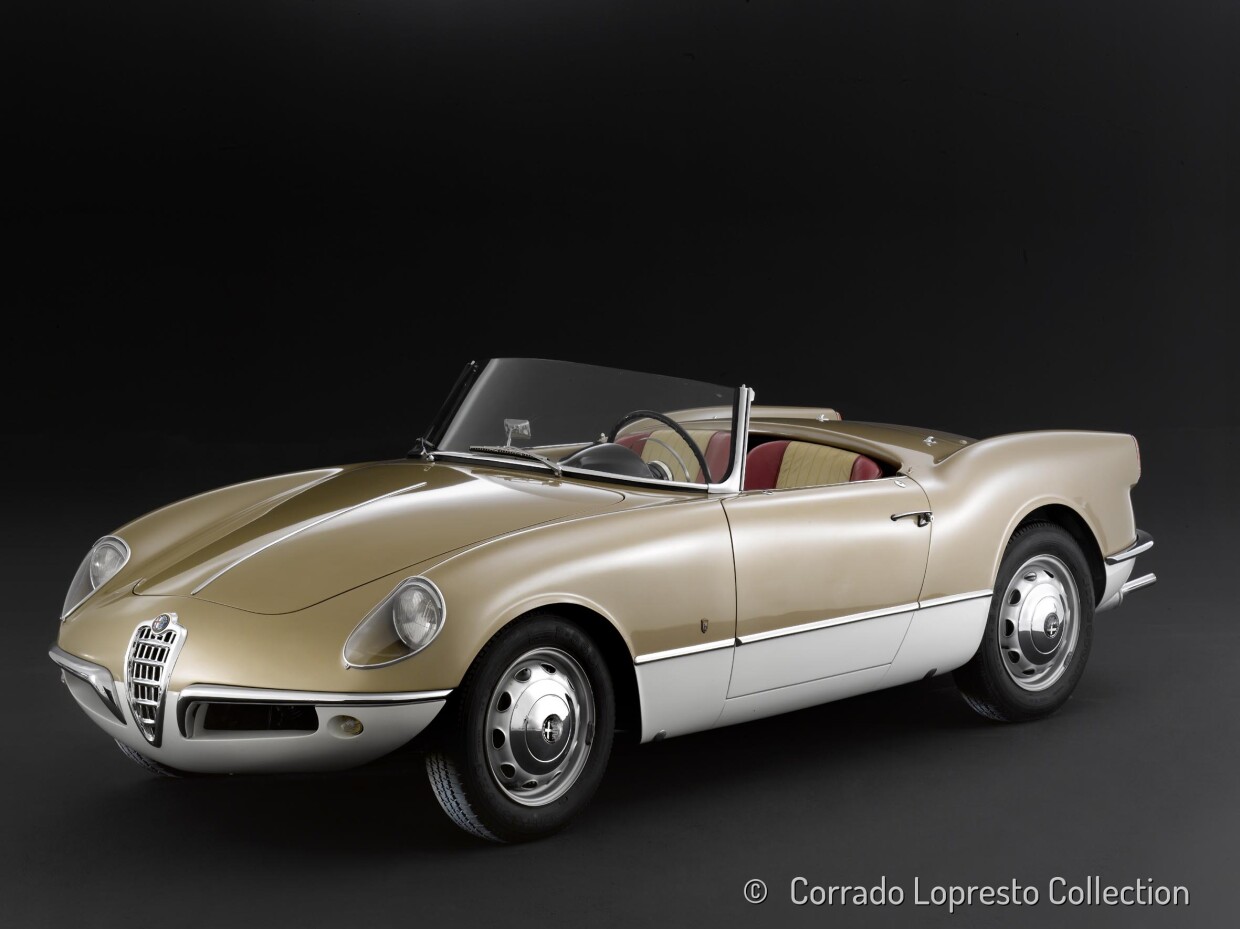
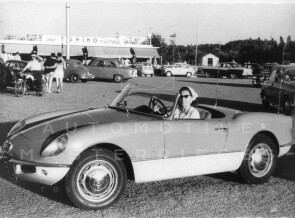
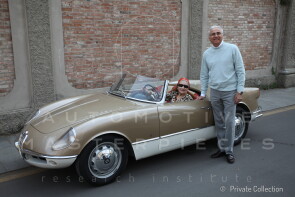
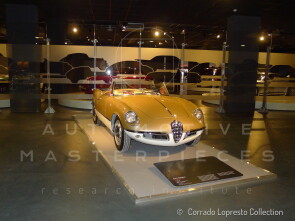
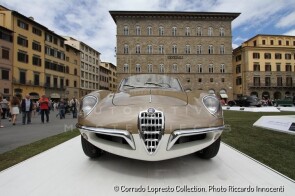
One of two prototypes of the Giulietta Spider built by Bertone and designed by Franco Scaglione. It remained a concept and is a star in concourses d'elegance.
Why am I an Automotive Masterpiece?
A. Concept and show cars
B. Prototypes
C. One-off models
D. Remaining cars from extremely limited production runs
E. Historic event cars
F. Cars owned by famous people
G. Team cars
H. Works cars
I. Press cars
J. Movie cars
K. Famous chassis’ cars
L. Limited edition cars
In the early 1950s Alfa Romeo was completing its transition from limited-production cars to large-scale manufacturing. The first major step had been the 1900, introduced in 1950, while the Giulietta project was intended to extend the same process into a smaller and less expensive market segment. Internally identified as the Tipo 750, the new model was originally planned around a four-door saloon, but delays in its development led Alfa Romeo to introduce the coupé first. The Giulietta Sprint was unveiled at the Turin Motor Show on 21 April 1954, followed in 1955 by the Berlina and the Pinin Farina Spider. The range subsequently expanded to include the Sprint Veloce and Spider Veloce, the Sprint Speciale, the Zagato-bodied SZ and other less common derivatives. A central feature of the Giulietta was its 1,290 cc four-cylinder engine, with light alloy block and cylinder head and twin overhead camshafts. Alfa Romeo described it as the first series-production engine of this type made entirely in aluminum. In the original Berlina it produced approximately 50-53 hp, while the Sprint initially offered 65 hp; higher-output versions followed as the range developed. Power was transmitted to the rear wheels through a four-speed gearbox. The Giulietta also introduced Alfa Romeo to production volumes on a scale previously unknown to the company. The 100,000th example was completed at Portello around the beginning of 1961, while total Giulietta production between 1954 and 1965 reached 177,690 cars in the various body styles and derivatives. More than 130,000 of these were saloons. During production, the original Tipo 750 series was progressively replaced by the revised Tipo 101 specification. The changes differed according to model and included modifications to chassis dimensions, mechanical components, body details and interiors. In the case of the Spider, the transition to Tipo 101 took place in 1959 and included an increase in wheelbase from 2,200 to 2,250 mm. In June 1962 Alfa Romeo introduced the Giulia TI saloon, powered by a 1,570-cc development of the same basic twin-cam four-cylinder engine. The change from Giulietta to Giulia did not immediately replace all the existing body styles. Instead, some Giulietta-derived models remained in production and were adapted to the new 1.6-litre mechanical specification. This resulted in models such as the Giulia Sprint and Giulia Spider, which retained the established Bertone and Pinin Farina bodies while adopting the larger engine and other mechanical developments associated with the new generation. They therefore formed a direct technical and chronological link between the Giulietta introduced in 1954 and the entirely new Giulia-derived coupés and spiders that followed during the 1960s.
The Giulietta Spider was developed shortly after the Sprint and Berlina as the open version of Alfa Romeo’s new compact range. An important role in the project was played by Max Hoffman, the influential New York importer who had already encouraged several European manufacturers to develop models specifically suited to the American market. Hoffman saw considerable potential in a small Alfa Romeo open sports car and pressed the company to add such a version to the Giulietta range. Alfa Romeo asked both Bertone and Pinin Farina to prepare proposals. Bertone’s prototypes, developed under Franco Scaglione, adopted a markedly sporting treatment, while Pinin Farina proposed a cleaner and more restrained design. Alfa Romeo selected the latter for production. The resulting two-seat Spider retained the main mechanical components of the Giulietta but used a substantially shorter chassis: the original Tipo 750 D had a wheelbase of 2,200 mm, compared with 2,380 mm for the Sprint and Berlina. The first Giulietta Spiders were completed in 1955, and the model made its public debut during that year’s European motor-show season. Series production expanded rapidly from 1956. The body was built by Pinin Farina, while the mechanical specification was centred on Alfa Romeo’s 1,290 cc all-aluminum twin-cam four-cylinder engine, driving the rear wheels through a four-speed gearbox. The standard Spider was joined in 1956 by the higher-performance Spider Veloce, distinguished mechanically by, among other features, twin Weber carburetors and a higher state of engine tune. In 1959 the Spider was revised from the original Tipo 750 D specification to Tipo 101.03. The wheelbase increased from 2,200 to 2,250 mm, while a number of mechanical, body and interior details were modified. The revised standard 1,290 cc engine produced approximately 79 hp, while the corresponding Tipo 101.07 Spider Veloce developed about 96 hp. Further detail changes followed during the final years of Giulietta Spider production. In total, approximately 14,300 standard Giulietta Spiders and 2,800 Spider Veloce were produced between 1955 and 1962. The introduction of the Giulia range in 1962 did not immediately bring an entirely new open model. Instead, Alfa Romeo retained the established Pinin Farina body and adapted it to the new 1,570 cc Giulia mechanical specification. The resulting Giulia Spider, Tipo 101.23, combined the existing 2,250 mm-wheelbase structure with the larger twin-cam engine and a five-speed gearbox. Externally it remained very close to the late Giulietta Spider, the most immediately recognisable difference being the raised section on the bonnet required to accommodate the taller 1.6-litre engine, together with revised badging. The Giulia Spider remained in production until 1965. A more powerful Giulia Spider Veloce, Tipo 101.18, followed in 1964. The model therefore represented the final development of the Pinin Farina Spider introduced in 1955, bridging the Giulietta generation and the completely new Alfa Romeo Spider introduced in 1966.
The commercial success of the Giulietta Sprint induced Max Hoffman, Alfa Romeo importer in the USA, to promote an open version and a tender was called between the Carrozzeria Bertone and Pinin Farina in 1955. Bertone entrusted the task of interpreting the theme of a two-seater sports car to Franco Scaglione and proposed two units of an original prototype; a proposal of high impact, but also of great building complexity. The car had a shorter wheel base compared to the Sprint model (2250 against 2380 mm) and a bodywork distinguished by strongly shaped fenders. It was not followed up in production. This chassis, no. AR1495*0004 is the surviving one of the two examples produced. The car has a traced history of owners, especially ladies, in the early years. And, although a unique and prototype example, it has nevertheless seen a tourist use. In 2000 it underwent a complete restoration which restored its ancient splendor and original livery. In more recent years it has become part of Corrado Lopresto's collection of unique pieces and has seen an intense participation in events and concourses d'elegance.