
Researches
& updates
& updates
Ongoing
1955 Porsche Spyder Typ 550/1500 RS
Chassis no.
550-0047
Engine no.
90051
Coachbuilder
Karosserie Wendler Reutlingen
Beacon
ON/OFF
ON/OFF
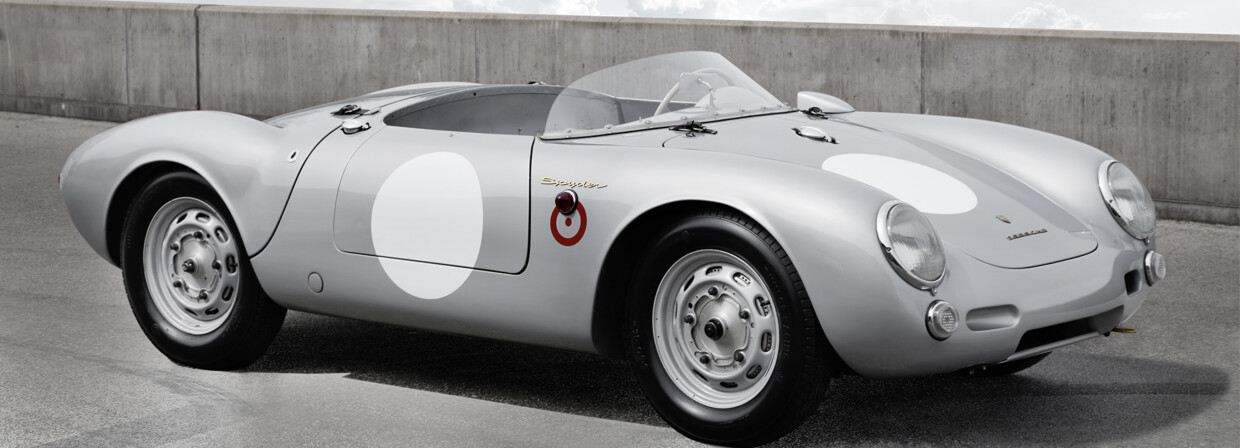
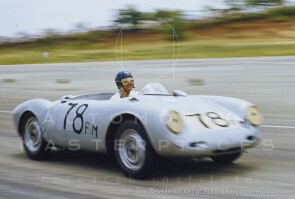
One of estimated 13 factory-entered Porsche 550s. Raced Le Mans, Sebring, Nürburgring. Driven by von Trips, McAfee, Levy—the only one raced by Moss. SCCA winner.
Why am I an Automotive Masterpiece?
A. Concept and show cars
B. Prototypes
C. One-off models
D. Remaining cars from extremely limited production runs
E. Historic event cars
F. Cars owned by famous people
G. Team cars
H. Works cars
I. Press cars
J. Movie cars
K. Famous chassis’ cars
L. Limited edition cars
L. Limited edition cars
no. 90 manufactured, 47th built
Between the late 1940s and early 1950s, Porsche consolidated its first industrial and sporting activities with the production of the 356/2 “Gmünd”, assembled in the small Austrian facility in Carinthia. During that period, production was gradually transferred to Stuttgart, into a plant shared with Reutter coachworks, a technical partner since the earliest prototypes. However, the German brand needed a true racing success—something that could serve as a sounding board to boost sales. Moreover, up until 1952, the company still lacked an official emblem to present itself on international markets. A decisive impulse came from Max Hoffmann, a brilliant talent scout and importer who introduced the 356 to the American market, paving the way for Porsche’s first major commercial success overseas. Within this context of brand development, the Porsche crest was born: Franz Xaver Reimspiess, already credited with designing the Volkswagen logo in 1936, created an emblem featuring the rearing horse (symbol of the city of Stuttgart), framed by red and black stripes and stylized deer antlers derived from the coat of arms of Württemberg, now part of Baden-Württemberg. At the time, Porsche’s limited resources did not allow for a direct investment in factory-backed racing efforts. Thus, independent initiatives played a vital role. One of the most important came from Walter Glöcker, a former motorcycle racer and later a Volkswagen and Porsche dealer in Frankfurt. Together with engineer Hermann Ramelow, Glöcker developed several “special” cars using Porsche mechanicals. These cars, conceptually inspired by the original 356/001 barchetta, were built on custom tubular frames with mid-mounted Porsche engines and reworked rear suspensions. The first Glöcker-Porsche was completed in 1949, followed by a second, more refined version in 1950—some with engines downsized to 1,000 cc to comply with the sub-1100 class regulations. The bodywork was crafted by C.H. Weidenhausen of Frankfurt in a barchetta style with clear racing intent, visually reminiscent of early Porsche prototypes yet entirely original in execution. Glöcker’s car won the German championship in its class in 1950 and repeated the feat in 1951 (the same year Ferdinand Porsche passed away, on September 3rd) and again in 1952. These victories demonstrated the potential of a lightweight, purpose-built racing Porsche. Such results were instrumental in pushing the factory toward developing an official sports car, fully designed for competition. It was no longer sufficient to modify the 356 or rely solely on external support: the time had come to create Porsche’s first true racing model, directly inspired in spirit and construction by Glöcker’s barchettas.
The Porsche Spider type 550-1500RS, introduced at the 1953 Paris Auto Show, is one of the best-known icons of a racing car. Developed as a purpose-built machine, it was the result of an ideal fusion between the acclaimed Ferry Porsche's 356 and the racing prototypes built and driven by Walter Glöckler in the early 1950s. The internal project, numbered 550, began in 1952 on a tubular frame derived from the work of Hermann Ramelow, with wheelbase and tracks similar to those of the 356 and comparable suspension, wheels and brakes. The technical direction of the project was entrusted to Ernst Führmann, who designed the all-new Type 547 engine. This complex and compact 1.5-liter boxer-four was air-cooled and equipped with four overhead camshafts, actuated by bevel gearshafts rather than chains or belts. The architecture, reminiscent of the Cisitalia-Porsche designs of the late 1940s, was so sophisticated that its assembly required no fewer than 120 hours by a skilled technician. It became the foundation for all air-cooled Porsche engines through 1998. The first bench tests of the 547 engine in April 1953 yielded over 110 hp at nearly 6,500 rpm. However, as the unit was not ready for racing, the first 550 prototypes entered the Eifelrennen in May with the older 1500 Super engine. A promising class win led to Porsche's entry into the 1953 24 Hours of Le Mans, with two aerodynamic coupé-bodied 550s, which finished 15th and 16th overall and first and second in their class. From 1954 onwards, the 550 RS entered full-time competition, achieving major international victories: class wins at the Mille Miglia, Le Mans, Carrera Panamericana, and the 1000 km of Buenos Aires, among others. In 1955, Porsche prioritized customer teams, with cars still achieving outstanding results at Sebring, Le Mans (4th to 6th overall), the Tourist Trophy, and the Targa Florio. The model proved to be a consistent class winner, cementing Porsche's presence in endurance racing. Technically, the 550 featured the 1.5-liter Type 547 flat-four engine mounted behind the driver, paired with a transaxle gearbox. This mid-engine layout gave the 550 far better weight distribution than the 356. Brakes with finned drums on all four corners provided stopping power, typical of the era. The suspension design echoed contemporary Porsche systems but was paired with a new ladder-type tubular chassis—lightweight, rigid, and efficient. In 1956, the 550 A was introduced as an evolution of the model. It featured a new, lighter spaceframe chassis, updated rear suspension, improved aerodynamics and brakes, and a revised body built by Wendler Karosserie. Works cars weighed around 530 kg; customer cars about 570 kg. Engine development continued as well, with the Type 547/2 reaching up to 125 hp, and later evolutions exceeding 135 hp. The model became the base for the later 718 RSK. The 550 was notably low and light, with an excellent center of gravity and an outstanding power-to-weight ratio—the keys to its nickname: "giant killer." A well-known anecdote tells of German F1 driver Hans Herrmann driving a 550 under closed railroad gates during the 1954 Mille Miglia. Another notable aspect was that the car could be driven to the track, raced, and then driven home: a true dual-purpose machine. Though each Spyder was customized, there were often several in a race. Teams painted colored stripes or fins on the rear fenders to distinguish them in the pits, since most cars were painted silver—Germany's official racing color. Porsche was also the first manufacturer to adopt race sponsorship on its cars. While Reutter bodied the 356 road cars, the 550's bodywork was crafted by Wendler Karosserie of Reutlingen. Like many coachbuilders, Wendler had started as a carriage maker in the late 19th century and became known after WWII for its mastery of ponton-style bodies. The 550 represented the pinnacle of Wendler's contribution. The legend of the 550 also has a dark chapter: the car known as "Little Bastard," owned by actor James Dean. Dean purchased the car while wrapping up filming on Giant in September 1955. He was en route to the Salinas Road Race when he fatally crashed. From that moment, both the man and the car entered into myth. As for the car's name, a final anecdote tells that Ferry Porsche, grateful to Piero Dusio for having helped secure the release of Ferdinand Porsche and Anton Pïech after the war, chose to adopt the term "Spyder" in homage to Dusio's 1947 Cisitalia 202 Spyder Mille Miglia.
The 1955 Porsche Spyder Typ 550/1500 RS with chassis no. 550-0047 was built in May 1955 with Wendler bodywork and equipped with engine number 90051. It is one of the estimated 13 known Porsche 550 Werkswagen (factory-entered cars), identified based on historically documented factory entries and appearances in major international events between 1953 and 1956. As a factory car, it was immediately entered by Porsche in the World Sportscar Championship painted in German racing silver, with green darts to be recognized among the other spyders on the track. Its first race was the (tragically famous) 24 Hours of Le Mans in June. The car, wearing race number 62, was driven by Helm Glöcker and Jaroslav Juhan. It finished sixth overall (273 laps completed versus 307 by the winner) and third in the under-1.5-liter class. The following month, in July, it competed in the Lisbon Grand Prix with Stirling Moss at the wheel. The British ace, evaluating possible team engagements after Mercedes-Benz withdrew from racing following the Le Mans tragedy, drove car number 3 to victory on the Monsanto circuit. In August, the factory Porsche 550s participated in the Goodwood 9 Hours. Seidel and Steed, driving the Typ 550/1500 RS number 35, finished third in class, while Moss, again driving 550-0047 (number 34) alongside Huschke von Hanstein, retired following an accident. On August 28, the car raced in the Nürburgring 500 Kilometers: Herbert Linge and Richard von Frankenberg, car number 2, finished second overall and second in the Sport up to 1.5-liter category. The season ended with the Berlin Grand Prix at the Avus circuit on September 25, where von Frankenberg won the race ahead of Richard Rosenhammer and Paul Thiel. In March 1956, the agile Spyder began the season at the 12 Hours of Sebring. Hans Herrmann and Wolfgang von Trips (car no. 41) drove an excellent race and finished sixth overall and first in class. Embracing the "race on Sunday, sell on Monday" philosophy, Porsche AG sold 550-0047 after the race to John Edgar’s team, which entered the car in the national SCCA championship. In its American campaign, the 550-0047 was driven mainly by Jack McAfee, who secured a string of excellent results in prestigious venues like Pebble Beach (victory), Cumberland (multiple wins), and Road America (first overall). He frequently placed on the overall and class podiums, often battling drivers like Carroll Shelby. McAfee’s consistent success culminated in winning the national championship at the end of the season. In 1957, the car continued its racing career with new drivers including Skip Hudson, Ruth Levy, and Lance Reventlow, taking part in events across the West Coast and even Hawaii. Highlights included multiple class wins and outright victories by Ruth Levy, who became the car’s most frequent and successful female driver. In 1958, under the ownership of Stan Sugarman, the car continued to appear in regional and national events, scoring modest but consistent results. In 1959 it raced at the Carrera del Norte, where it finished second in class. Its last known race was the 4 Hours of Vaca Valley on November 4, 1963, where David Love and Gordon Mills finished 10th overall. No confirmed race entries have been found for the car beyond that date. As is often the case with high-level racing cars, the vehicle underwent changes in livery and technical details over the course of its career. Among the most significant were modifications to the rear hood, introduced after the first competitions to improve the expulsion of hot air from the engine. Another element that varied during the races was the use of a tonneau cover over the unused passenger seat, as well as the occasional fitment of an aerodynamic fairing behind the driver’s headrest. Distinctive features of this particular example include a simple aerodynamic screen in front of the driver instead of a full windshield and, mechanically, the frequent adoption of twin exhausts rather than the more common single pipe. The car has since been the subject of a major restoration, carried out with respect for its original configuration.