Researches
& updates
& updates
Ongoing
1957 Alfa Romeo Giulietta Sprint Speciale
Chassis no.
AR1012000001
Engine no.
AR0012000003
Coachbuilder
Bertone
Beacon
ON/OFF
ON/OFF
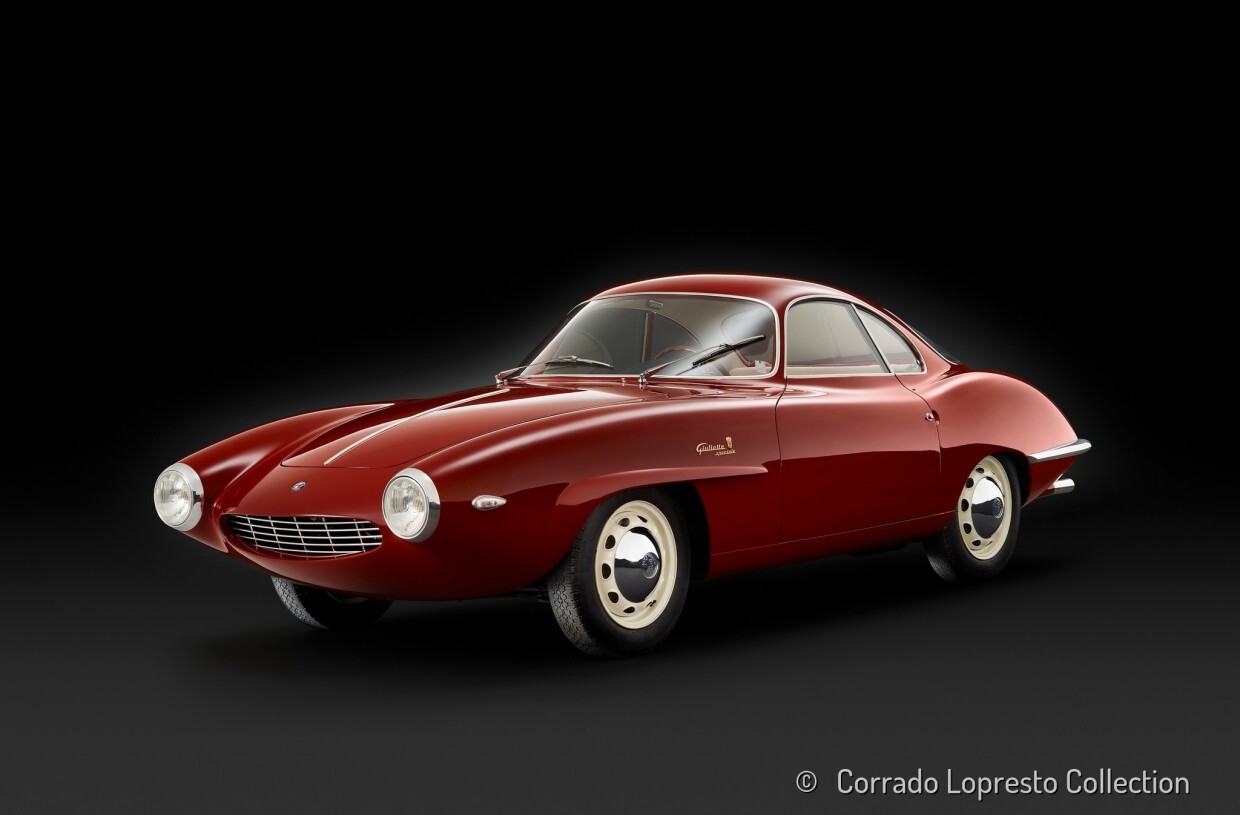
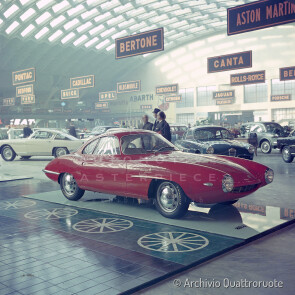
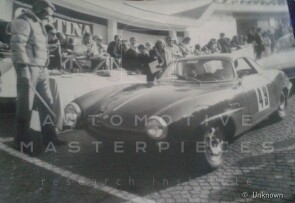
The first prototype of the Giulietta Sprint Speciale. It was presented at the 1957 Salone dell'Auto di Torino, featuring a highly refined study of aerodynamic.
Why am I an Automotive Masterpiece?
A. Concept and show cars
B. Prototypes
C. One-off models
D. Remaining cars from extremely limited production runs
E. Historic event cars
F. Cars owned by famous people
G. Team cars
H. Works cars
I. Press cars
J. Movie cars
K. Famous chassis’ cars
L. Limited edition cars
Post-war economic development gave a powerful boost to the automotive industry. Mass motorization had begun, and artisanal production methods and limited manufacturing capacity had to give way to the logic of large-scale assembly-line production in order to meet growing customer demand. For Alfa Romeo, this delicate transition coincided with the design and production of the Giulietta, internally identified as the “Tipo 750”. Unusually, the new model was introduced first as a coupé and only later as a saloon. Technical problems delayed the beginning of production compared with the debut originally scheduled for the 1954 Turin Motor Show. The development of the car had been financed through a public capital subscription and was linked to a national lottery in which a car was offered as a prize, making any further postponement of the launch particularly difficult. For this reason, at the end of 1953 Alfa Romeo took the unusual decision to present the coupé before the saloon. The sporting version was intended to strengthen the connection between the new model and Alfa Romeo’s traditional involvement in competition. The original company programme envisaged a coupé based on the saloon’s mechanical components, to be introduced later and produced in limited numbers by Milanese coachbuilders. Instead, the design and development of the coupé proceeded in parallel with those of the saloon. An early prototype created within Alfa Romeo by Giuseppe Scarnati later became known as the “brutto anatroccolo” (i.e. ugly duckling). Coachbuilders such as Zagato and Touring were unavailable, as they were already fully occupied with other Alfa Romeo projects. Rudolf Hruska, who was responsible for the Giulietta programme, therefore sought the assistance of Mario Boano, then involved with both Ghia and Bertone, and enlisted Giovanni Michelotti as a consultant. Franco Scaglione and a very young Giorgetto Giugiaro also contributed to the refinement of the design, much of which was carried out under Boano’s direction. The numerous modifications, while respecting the original volumes, gave the body a pleasing, balanced and unmistakably sporting appearance. This is how the Giulietta Sprint was born. It was officially unveiled as a pre-production model at the Turin Motor Show on 21 April 1954. As was customary for Alfa Romeo, the relatively small 1,290 cc engine featured twin overhead camshafts, and its “roar” remained unmistakably that of an Alfa. The success of the new model was such that the company was immediately forced to revise its production plans. Carrozzeria Bertone had to cope with an unexpectedly high number of orders and subcontracted part of the body construction to specialist Turin panel beaters. The earliest body shells were therefore largely handmade. Automated pressing of the panels began only in 1960. The Sprint bodies were produced in Turin and then transported by car carriers to Alfa Romeo’s Portello plant in Milan, where the engines, mechanical components and interiors were installed. Thanks to a higher compression ratio than that of the saloon and a twin-choke carburettor, the Sprint’s all-aluminium 1,290 cc engine produced 65 hp at 6,000 rpm, enabling the car to reach approximately 160 km/h. The elegant body lines and the price of 1,900,000 Lire also contributed to its success. Although this was not inexpensive in absolute terms, it was still considerably less than the price of the larger and more exclusive 1900 Super Sprint. At first, the Giulietta Sprint was offered in only four colours: Rosso Alfa, Blu Tornado, Bianco Gardenia and Azzurro Capri. Its competition debut came at the 1955 Giro di Sicilia, after which its presence became increasingly widespread in the principal road races, circuit events and hill climbs of the period. The attempt to position the Giulietta Sprint in a more accessible market segment proved highly successful. The Giulietta saloon followed in the spring of 1955, while the Spider was unveiled in the autumn at the Frankfurt Motor Show. Production figures for the Giulietta range quickly became significant: from just 12 cars built in 1954, output rose to 1,415 in 1955 and 1,855 in 1956. The price of the Sprint increased slightly over time, while the car received continuous technical updates. These included the adoption of a revised gearbox with Porsche-type synchromesh in place of the original Borg-Warner system. Production methods and mechanical specifications were later progressively unified with those of the Sprint Veloce. The Giulietta Sprint continued to evolve through several phases. From 1962, the same Bertone body was adapted to the 1.6-litre Giulia mechanical specification and marketed as the Giulia Sprint, while a 1.3-litre version later returned to the range. Production of this body style finally ended in 1965. In total, 24,084 Giulietta Sprint coupés were built, within an overall production of 177,513 cars belonging to the Giulietta family. The model marked a decisive turning point in Alfa Romeo’s history, successfully transferring the marque’s sporting image, technical sophistication and distinctive character into a form suitable for modern series production.
Just in time for the 1956 Mille Miglia, the Giulietta Sprint was joined by the more sporting Sprint Veloce. Distinguished by reduced weight, increased power and numerous mechanical refinements, the Veloce was immediately recognizable by details such as its sliding side windows. The 1,290 cc twin-cam engine, equipped with twin twin-choke horizontal Weber carburettors, developed up to 90 hp, allowing a top speed of approximately 180 km/h. These improvements quickly established the Sprint Veloce as one of the most competitive Grand Touring cars in its class and made it the preferred choice of many gentleman drivers. Its competition record began almost immediately, highlighted by Sgorbati's remarkable eleventh place overall in the 1956 Mille Miglia. During 1957, approximately 700 examples were built. The success achieved by the Sprint Veloce encouraged Alfa Romeo to explore an even more advanced interpretation of the Giulietta concept. The objective was to create a compact Gran Turismo capable of exceeding the symbolic 200 km/h barrier through extensive aerodynamic research rather than a substantial increase in engine displacement. The result was the Giulietta Sprint Speciale, first presented in prototype form at the 1957 Turin Motor Show. Designed by Franco Scaglione and built by Carrozzeria Bertone, the Sprint Speciale clearly reflected the aerodynamic research previously explored in Scaglione's celebrated B.A.T. (Berlinetta Aerodinamica Tecnica) experimental concept cars. Every element of its bodywork was conceived to reduce drag: the low nose, faired-in headlamps, pronounced front wings, panoramic windscreen, flowing roofline and tapered tail combined to produce one of the most advanced aerodynamic designs of its era. With a drag coefficient of approximately 0.29, the Sprint Speciale remained one of the most aerodynamically efficient production cars of the late 1950s. Although visually dramatic, the Sprint Speciale was not conceived as a pure competition car. Instead, Alfa Romeo positioned it as the most exclusive and sophisticated member of the Giulietta family, combining advanced aerodynamics with refined road manners and high-speed touring capability. The production version, introduced in 1959 after further development and detail revisions, retained the essential styling of the prototype while incorporating numerous improvements required for series manufacture. Built on a slightly shorter wheelbase than the standard Giulietta Sprint, the Sprint Speciale was powered by the Veloce-specification all-aluminium 1,290 cc twin-cam engine equipped with twin Weber twin-choke carburettors. Delivering up to 100 hp in early production and later 112 hp in its final evolution, it allowed the remarkably aerodynamic coupé to approach, and in some versions exceed, 200 km/h, fulfilling the objective that had inspired its development. Produced between 1959 and 1962, only 1,366 Giulietta Sprint Speciales were built, making it one of the rarest and most technically sophisticated members of the Giulietta family. Today it is widely regarded as one of Franco Scaglione's finest production designs and one of the milestones of post-war Italian automotive styling.
Chassis no. AR10120*00001 is the first Alfa Romeo Giulietta Sprint Speciale prototype and the car unveiled by Bertone at the 1957 Turin Motor Show. Designed by Franco Scaglione, it represented the first concrete development of the aerodynamic principles explored between 1953 and 1955 through the celebrated B.A.T. prototypes. Conceived as an exclusive and particularly fast interpretation of the Giulietta Sprint, it was developed with the objective of allowing Alfa Romeo’s relatively small 1.3-litre engine to approach the symbolic 200 km/h barrier through advanced aerodynamic efficiency. The prototype displayed a number of features that distinguished it markedly from the later production Sprint Speciale. Its proportions were more extreme, its surfaces more experimental and its body was entirely hand-formed in aluminium alloy. The front treatment, in particular, differed substantially from the familiar Alfa Romeo grille arrangement subsequently adopted for the series-built cars. These characteristics make chassis 00001 not merely an early example of the Sprint Speciale, but the original styling and aerodynamic prototype from which the model was developed. Following the enthusiastic reception of the Turin show car, the design underwent further development before production began in 1959. The definitive Sprint Speciale retained the essential aerodynamic philosophy and unmistakable character of Scaglione’s original concept, while adopting less extreme proportions and construction methods better suited to limited-series manufacture in steel. Chassis AR10120*00001 was sold by Alfa Romeo in 1960. During its subsequent life, the car underwent alterations that modified some of its original styling features. A meticulous restoration later returned it to the distinctive configuration in which it had appeared at the 1957 Turin Motor Show, reinstating the original form of Scaglione’s design and preserving its unique aluminium bodywork. Now part of the Lopresto Collection, chassis 00001 occupies a particularly important position in the history of post-war Alfa Romeo design. It is the first Sprint Speciale, a direct link between the experimental B.A.T. berlinettas and the production model introduced two years later, and a unique record of one of Franco Scaglione’s most advanced aerodynamic studies.