
Researches
& updates
& updates
Ongoing
1953 Ferrari 342 America
Chassis no.
0242/AL
Engine no.
0242/AL
Coachbuilder
Pinin Farina
Beacon
ON/OFF
ON/OFF

One of only six Ferrari 342 Americas for the jet set, second of three Pinin Farina-bodied coupes, marking the start of Ferrari's relationship with Pinin Farina.
Why am I an Automotive Masterpiece?
A. Concept and show cars
B. Prototypes
C. One-off models
D. Remaining cars from extremely limited production runs
E. Historic event cars
F. Cars owned by famous people
G. Team cars
H. Works cars
I. Press cars
J. Movie cars
K. Famous chassis’ cars
L. Limited edition cars
L. Limited edition cars
no. 3 manufactured, no. 3 remaining, 2nd built
In July 1950, at the Nations Grand Prix in Geneva, Ferrari fielded the new 340 F1 single-seater. With a displacement of 4,101.66 cc, it was effectively an intermediate step towards reaching the 4.5-liter limit imposed by the regulations for naturally aspirated engines. The car, like the previous 275 F1, was built around Aurelio Lampredi’s “large” V12 engine. A few months later, the same engine was installed in a sports car: the 340 America, with which Ferrari aimed to strengthen its presence in the U.S. sports car market and intended to later offer in a grand tourer version.
With the production of the 340 America underway, Ferrari aimed to diversify its product to attract customers who, while intimidated by the performance of the racing version, were nonetheless captivated by the allure of the “Prancing Horse.” Production of the 340 in a GT version began once the model’s sporting reputation was established, bolstered by successes such as the victory of a 340 America driven by Gigi Villoresi and Pasquale Cassani at the 1951 Mille Miglia. In October of the same year, a Ghia-bodied coupe named the 342 America debuted at the Paris Salon de l’Automobile. However, the public and press response was not as positive as hoped but matters improved with the small-scale production that began the following spring, featuring designs first by Vignale and then by Pinin Farina, who created the most original and elegant versions of the new vehicle. This marked the beginning of a successful collaboration with Ferrari, who was seeking a “trusted” designer for its grand tourers and increasingly turned to the Turin-based atelier. The designation “342” was unusual, as it did not follow the convention of indicating the unitary displacement. The 342 America was intended for an elite clientele, not necessarily focused on sportiness, and was designed for road use. Accordingly, Lampredi’s 4.1 L engine was “tamed”: the rev limit was lowered to 5,000 rpm compared to the 6,000 rpm of the 340, achieving more balanced performance. The wheelbase extension to 2,650 mm enhanced comfort, allowing for possible 2+2 seating and making the chassis less “twitchy,” thus improving driving predictability. The choice of a four-speed synchronized gearbox also improved the car’s drivability. One of the model’s early patrons who contributed to its fame was former King Leopold III of Belgium, a figure often in the spotlight, who commissioned a black Pinin Farina cabriolet with light interiors and a 4.5 L engine (chassis number 0234/AL). This was followed by a silver cabriolet (chassis number 0248/AL), which was exhibited at the 1953 New York Motor Show, where Pinin Farina showcased the clean and elegant lines previously seen on the 212 Inter. It was notable for its rather generous and prominent grille, as well as the understated design where every detail was carefully crafted to enhance the purity of the surfaces. For example, the door handle was recessed into the bodywork, which was accentuated only by a chrome line along the lower section. The Turin coachbuilder also crafted three coupes (chassis numbers 0240/AL, 0242/AL, 0246/AL), each with a distinct stylistic personality—the first in silver, the second in blue, and the third in black; all featured the prominent grille and a panoramic rear window. In total, Ferrari produced six examples of the 342 America between late 1952 and 1953: one Vignale cabriolet, two Pinin Farina cabriolets, and three Pinin Farina coupes.
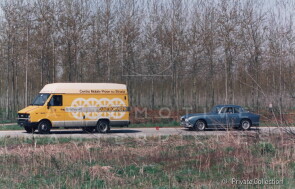
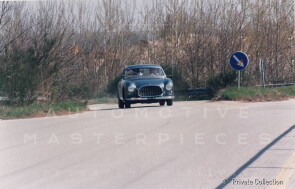
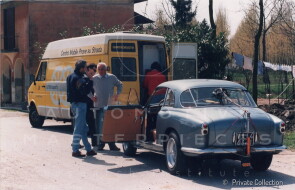
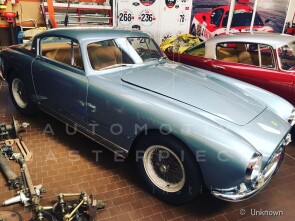
The Ferrari 342 America chassis number 0242/AL is the second of the chassis to be bodied as a coupé by Pinin Farina. The 0242/AL was similar to 0240/AL, presented at the Paris Motor Show in 1951, in the front end with round position lights, and at the rear with the small vertical twin lamps at the top of the short fins terminating the rear fenders. By contrast, the third example, 0246/AL, featured rectangular front position lights and a more rounded tail, with tapered lamps recessed into a more elaborate chromed surround. The feature that most clearly differentiates the three cars is the shape of the rear window: panoramic and divided into three sections on chassis 0240/AL, narrower and more conventional, set between two thick roof pillars, on chassis 0246/AL. Chassis 0242/AL represents a kind of “middle ground” between the two, with a still wide, three-piece rear window, but more compact in size, without the “Z” shape and with more traditional pillars. With its mechanics and chassis completed on December 9, 1952, it was sent to Pinin Farina for final assembly and was probably completed in early 1953. Pinin Farina records note the original colour as “Acquamarina” and indicate that the car was initially allocated to Commendatore Enzo Ferrari, before apparently being reassigned and delivered to its first private customer. Documentary evidence identifies the ILESA company as the first owner in 1953. ILESA was based in Cavazzale di Monticello (Vicenza) and was one of the leading Italian manufacturers of lighting products in the post-war period. The car was likely intended for use by the company’s owner or a senior member of its executive management. The car subsequently passed to Swiss collector Georges Filipinetti of Geneva later that same year. The car later moved to the United States, where it passed through several owners, including Warren Witt, before being acquired on October 15, 1970, by Edwin K. Niles in Los Angeles, California, who purchased it for USD 1,200. At that time the car was still fitted with its original engine and was running, despite a known issue with a small water pipe passing through the timing case, which allowed coolant to contaminate the oil. Niles drove the car in this condition and later sold it on July 7, 1971, to Charles Tillotson of Torrance, California, for USD 1,500, after deciding that a proper repair was not economically justified. During the early 1980s the car was offered for sale without its engine, which had been removed and installed in Ferrari 340 Mexico chassis 0222A. In this period the rolling chassis of 0242AL passed through several hands in California, including Jeff Lewis of Newport Beach and Joe Alphabet of Alpha Motorsports in Huntington Beach, and was offered publicly on multiple occasions between 1981 and 1983. The original engine, identified internally as number 7B, followed a complex and well-documented path: removed in the 1980s, rebuilt by Harold White, installed in the 340 Mexico in the Los Angeles area, and later sold with that car to Japan. The Mexico’s own original engine was subsequently discovered in another Ferrari, chassis 0325EU, before eventually being reunited with its original car. The engine of 0242AL was eventually reacquired by Thomas E. Shaughnessy while en route from Japan to the United States. It retains Weber 40DCF/3 carburetors numbered 149, 157 and 161, originally associated with 0222A, fitted with reduced jetting, as well as original 9 mm camshafts rather than remanufactured components. The original stamped engine number had been ground off during earlier ownership. By the mid-1980s the car had returned to Italy. The documents record a transfer of ownership in 1985 in favor of the Italian Giorgio Acutis. Curiously, the seller is listed as Charles Tillitson, to whom the car was evidently still formally registered. Another document dated 1990 records a sale by Acutis in favor of the actual owner, the collector who initiated its restoration and who would retain it for the decades to come. So, at the beginning of the 90s, the car is registered with license plate VA 44341, the body was restored by Salvatore Diomante, while mechanical work was carried out by Almo Bosato, and the car was refinished in metallic blue. Since July 2002 the Ferrari 342 America 0242AL has remained in the hands of an Italian collector, completing a long and complex history marked by transatlantic ownership, mechanical separation and eventual reunification, and several phases of restoration and use.