
Researches
& updates
& updates
Ongoing
1954 Lancia Aurelia B20
Chassis no.
*B20S-1047*
Engine no.
B20*3880*
Coachbuilder
Pinin Farina
Beacon
ON/OFF
ON/OFF
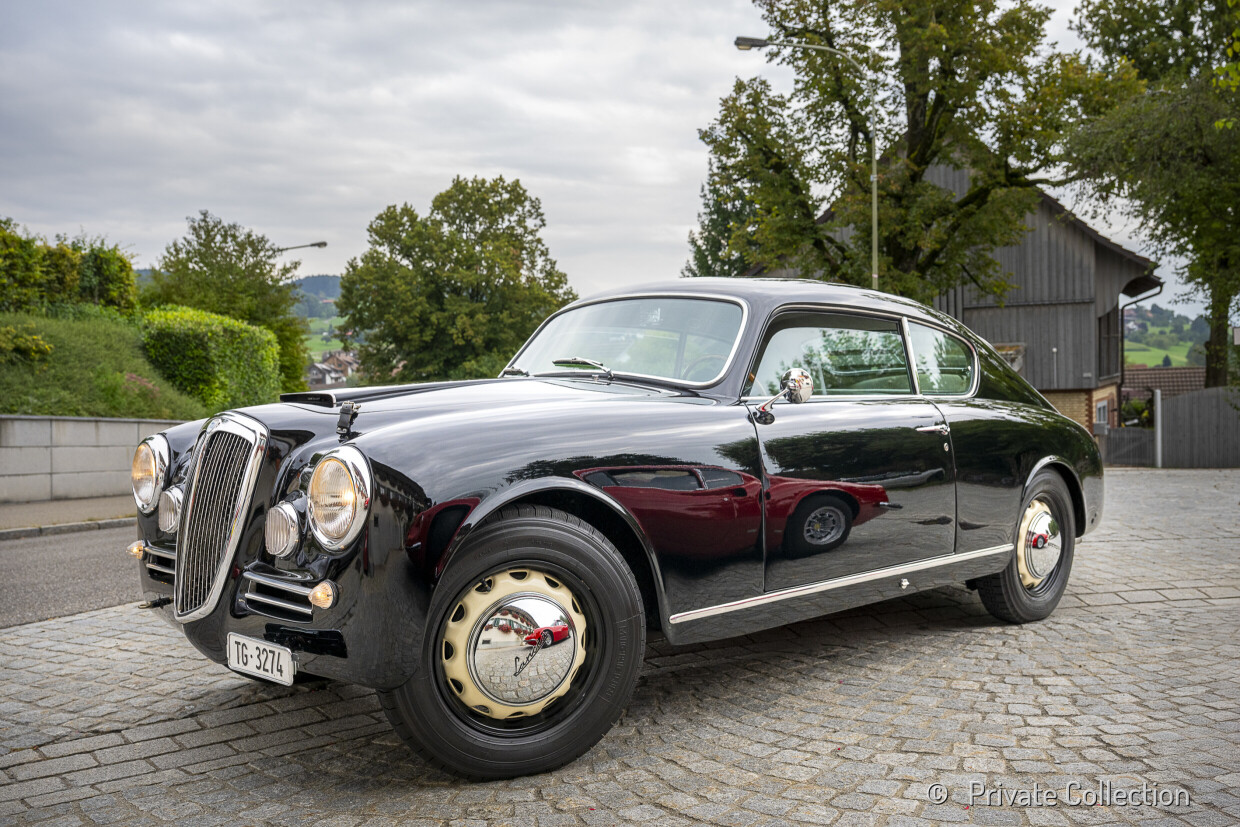
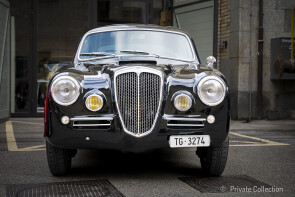
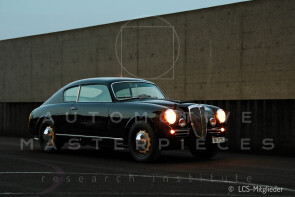
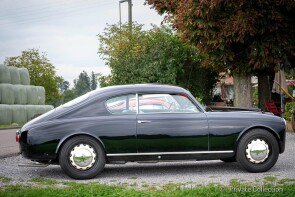
Rare LHD 4th series, one of only 255 in total. Fully documented ownership history. Never raced in period. Recent historic reenactments such as the Mille Miglia.
Why am I an Automotive Masterpiece?
A. Concept and show cars
B. Prototypes
C. One-off models
D. Remaining cars from extremely limited production runs
E. Historic event cars
F. Cars owned by famous people
G. Team cars
H. Works cars
I. Press cars
J. Movie cars
K. Famous chassis’ cars
L. Limited edition cars
L. Limited edition cars
no. 255 manufactured, 47th built. With the fourth-series B20S, produced in small numbers, the option of left-hand drive was introduced on the model.
The post-war period brought a desire, or rather a hunger, for renewal. Everything that suggested the past, before the war, needed to be forgotten or overcome. Cars became the primary symbol of this renewal, both in practice and in dreams. From its very first appearance, the Lancia Aurelia made a sensation, not only because, together with its contemporary Fiat 1400, it represented the first truly new "Italian" automotive product of the post-war period, but also for its technical innovations. Lancia’s revolutionary first post-war car, designed by Vittorio Jano, was introduced in 1950. It featured the first production V6 engine—a 60° design developed by Francesco de Virgilio—combined with a balanced transaxle gearbox and inboard rear brakes, all of which were groundbreaking innovations in post-war Europe. Developed in various versions, the B20 coupe was its pinnacle. The Aurelia Gran Turismo was introduced in 1951 as a coupé evolution (B20 type) of the B10 saloon with an engine that, finally, was introduced with a displacement at the class limit. This was the result of a new company-wide policy imposed by Gianni Lancia, who had taken over from his mother in 1947. The Aurelia engine had been increased to 1,991 cc in 1951 and, in its uprated form, was fitted into the B20. Lighter and with a higher gear ratio than the saloon, the B20 was capable of exceeding 160 km/h. Introduced in 1953, the 3rd and subsequent series B20s were powered by a 2,451 cc, 118 hp version of the pushrod V6. The design, created by Mario Felice Boano and refined and built by Pinin Farina, became an instant classic due to its smooth, clean lines and competition prowess. The car was immediately entered for the 1951 Mille Miglia, with three "private" examples, out of the four that were registered in the names of their drivers, finishing in the top seven overall and taking the first three places in class. Bracco-Maglioli finished second, beaten only by Villoresi’s Ferrari, which had over twice the displacement of the Lancia. Bracco, partnered by Lurani, later drove his car from Italy to France and finished 12th overall in the Le Mans 24 Hours. Lancia prepared seven "Corsa" versions of the car for 1952, six of which were entered by privateers. These cars secured 2nd, 3rd, and 4th overall in the Giro di Sicilia, finished 3rd, 5th, 6th, and 8th overall at the Mille Miglia, secured 1st, 2nd, and 3rd at the Targa Florio, placed 4th, 6th, 8th, and 9th in the Coppa d'Oro delle Dolomiti, and, when equipped with a supercharger, took 4th at the Carrera Panamericana.
The Aurelia B20 appears to have been classified “by series” only in the first two editions with a 2-liter engine, while the production of the 2.5-liter engine has never been officially classified by series, a subdivision that entered common use for greater immediacy. The 4th series shared the 118 hp 2.5-liter engine of the 3rd series, a more rounded rear without fins, and front lights without the "eyelids" introduced in the 3rd series. The 4th series also introduced left-hand drive on the coupés (already available as an option on the sedans) and the De Dion-type rear axle. New features included a reversing light and tinted windows; the steering wheel now had two spokes with a horn ring, and the instruments transitioned from a white background to black Jaegers, similar to those used on Ferraris. The "S" in the chassis number stands for "Sinistra" (i.e., left-hand drive). The left-hand-drive 4th series (chassis numbers from B20S-1001 to B20S-1130) is rarer; it was produced in 255 examples (130 in 1954), while the RHD version was built in 745 examples (494 in 1954).
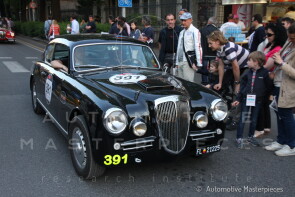
The Aurelia Gran Turismo 2500 (a name including both coupés and spiders), in the B20 coupé version with chassis no. B20S-1047, is a left-hand drive example of the so-called “Quarta Serie” (4th series). The “S” in the chassis number stands for “Sinistra” (i.e., left-hand drive). The B20S-1047 appears to be roughly in the middle of the 130 left-hand-drive examples built in 1954, and around one fifth of the entire 255-car production run. With a certificate of origin dated August 8, 1954, this car was purchased new directly from Lancia S.p.A. by Jaume Clavell, likely of Catalan origin. According to the Lancia Aurelia registers, it was originally finished in green, with beige cloth upholstery. The purchase price, expressed in U.S. dollars, reflects the international character of both the client and the transaction. Clavell died prematurely in February 1955 in Frankfurt, after having duly prepared his will and the succession of the car in favor of his wife and two daughters, who thus became co-owners of the vehicle and promptly arranged its sale. The mediation between the Clavell heirs and the new owner, Luciana Ala, was entrusted to the Milan-based Emanuele Dubini, an active commercial intermediary at the time. Later in 1955, the car passed to Lino Bosco, who kept it for a few years before selling it to Luciano Torchio in 1961; for this transfer, Francesco Vay acted as Bosco’s authorized representative, illustrating a period practice of relying on delegates for PRA formalities. In 1962, the car was purchased by Marco Renato, and two years later by Luigi Ferrini, who was succeeded in 1966 by Renzo Ferrian, assisted in the transaction by Edoardo Stefani. The car continued to circulate in private hands: in 1969 it was acquired by Andrea Fabbri, through the mediation of the company snc AVA, and was jointly owned with Teresa Dalla Villa for a notably longer period of ownership than the previous one: 20 years. By 1989 the Aurelia was owned by Giannandrea Calderazzo, who transferred the car to Franco Tralli in 2007. According to FIVA documentation, the car underwent two restorations, in 1998 and in 2002 and probably acquired its period blue livery with grey cloth upholstery; it was also likely during this restoration phase that the bonnet was modified or replaced with one already featuring a centrally positioned, handcrafted air intake. A further change of ownership occurred in 2011, when the car passed to Camillo Bertulezzi, remaining with him until 2013. Early that year, the car left Italy for the first time and its ownership passed to The Classic Car Trust founded by Fritz Kaiser, Liechtenstein wealth management entrepreneur, investor and philanthropist. Although no precise data are available, evidence indicates that at this stage the car underwent a further restoration, repainted black and, more significantly, prepared for participation in historic car competitions. The engine was tuned using techniques and components consistent with the period, including twin twin-choke carburetors on a Nardi aluminum intake manifold, while the original column-mounted gear lever was replaced with a Nardi floor-mounted conversion. The bachelite steering wheel was replaced with a three-spoke wheel from a later series, more comfortable seats were installed, and the bumpers were removed to reduce weight. The car took part in events such as the Mille Miglia in 2014 and 2016, confirming an active contemporary sporting life in historic re-enactment contexts. In 2014 it was driven by actor Luke Evans, while in 2016 it was driven by Alexander Ospelt. Since 2016, the car has been registered under Herbert Ospelt Anstalt, a Liechtenstein-based legal entity historically associated with the Ospelt Group, the well-known international food-processing company founded in 1958. The car is currently finished in black with grey cloth upholstery, a specification that likely dates from one of these restoration phases. Finally, around 2020, the Aurelia became part of the Collezione Il Maneggio, a private Swiss collection where it is still preserved.