
Researches
& updates
& updates
Ongoing
1953 Lancia Aurelia 2000
Chassis no.
B52-1097
Engine no.
B21-4775
Coachbuilder
Carrozzeria Alfredo Vignale & C.
Beacon
ON/OFF
ON/OFF
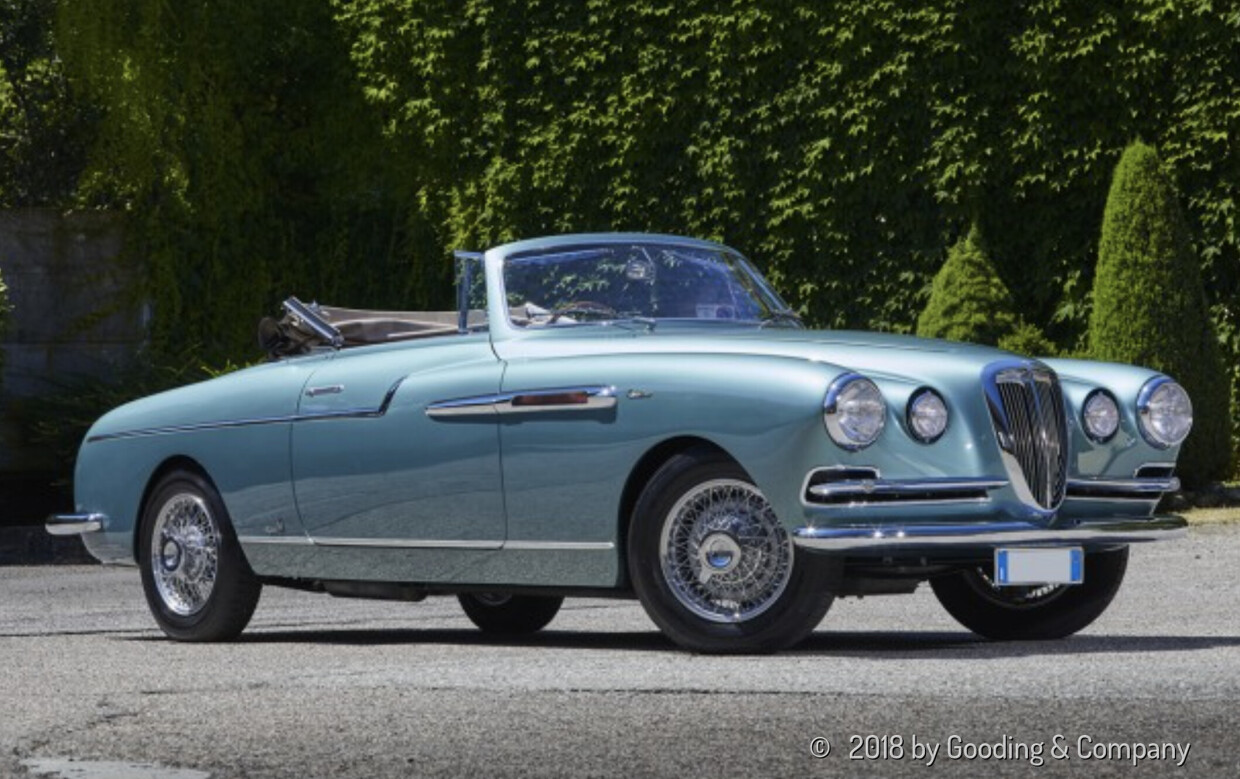
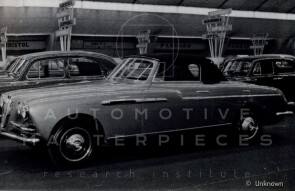
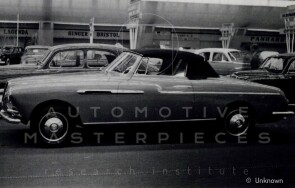
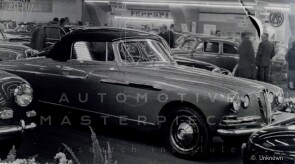
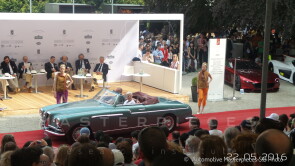
One-off Lancia Aurelia B52, designed by Michelotti, among very few Vignale convertibles, penultimate chassis produced. Exhibited at the 1955 Brussels Motor Show.
Why am I an Automotive Masterpiece?
A. Concept and show cars
B. Prototypes
C. One-off models
D. Remaining cars from extremely limited production runs
E. Historic event cars
F. Cars owned by famous people
G. Team cars
H. Works cars
I. Press cars
J. Movie cars
K. Famous chassis’ cars
L. Limited edition cars
L. Limited edition cars
. Effectively a one-off, yet belonging to a very limited group of Michelotti-designed Vignale Aurelia B52 convertibles built on the two-litre chassis.
The post-war period brought a desire, a hunger for renewal. People wanted to forget and surpass everything that reminded of the past and the time before the war. Cars were the "first" example of this thirst for novelty. Since its appearance, the Aurelia caused quite a stir, mainly because, together with the contemporary Fiat 1400, it represented the first genuinely new "Italian" automotive product of the post-war period. The first Lancia car of the post-war period, the revolutionary Aurelia designed by Vittorio Jano appeared in 1950. At the Salone di Torino, inaugurated on May 4, 1950, was exhibited the first of all the Aurelia cars, the B10 sedan, featuring a harmoniously rounded line. It boasted a series of revolutionary technical innovations. To mention a few: the first V-6 engine with a V of 60° as standard 1.8 litres, developed by Francesco de Virgilio, the monocoque with independent four-wheel suspension, the new gearbox/differential unit mounted in a transaxle layout, and inboard rear brakes. The bodywork was partly made of aluminium with the windshield and rear window in curved glass. In the Aurelia, especially in this first B10 version, the qualities of comfort, luxury and ride flexibility were favoured. A year later, in the spring of 1951, arrived an engine with a displacement of 2 litres, mounted on the new B20 coupe and, as an alternative to the 1.8 litres, on the sedan that takes the name of B21. The range of the "first series" Aurelia expanded further at the beginning of autumn 1952 when appeared a new lengthened limousine with 6-7 seats, the B15 type and a new version of the sedan (the B22) is added. Soon, the Aurelia platform would also become the basis for a series of special chassis intended for independent coachbuilders, opening the way to some of the most exclusive and elegant interpretations of the model.
The story of the Lancia Aurelia spans the years from 1950 to 1958. More specifically, the chassis intended for custom-built bodies by independent coachbuilders were produced between 1950 and 1956. Soon after the model’s public debut at the Salone di Torino in 1950, Lancia began offering bare chassis alongside the standard B10 sedan. According to the company’s forecasts, production of these rolling chassis – designated B50 (and B51 in a strengthened version to accommodate heavier bodies) – was expected to reach at least one thousand units. Despite the commercial logic of the initiative, and the inclusion of three special-bodied versions in Lancia’s own price list (the Pininfarina cabriolet and the Stabilimenti Farina coupé on the B50, and the Viotti “Giardinetta” on the more robust B51 platform), demand, though not negligible, remained below expectations. The reasons lay partly in the modest performance of the 1.8-litre engine when fitted with heavier coachbuilt bodies, and in the very high prices these cars commanded. In 1952, Lancia introduced the more powerful 2-litre engine already adopted on the B21 sedan. The new chassis thus equipped were designated B52 and B53: the B52 replacing the B50 as the standard chassis, and the B53 replacing the B51 for bulkier and heavier bodies. Total production of these 2-litre rolling chassis remained below two hundred units (184 in all). These rare platforms were used by many of the most renowned Italian coachbuilders, as well as by a few foreign firms such as the Swiss Beutler and Worblaufen. On the B52 chassis, Pininfarina built, among others, almost all of the celebrated PF200 show cars. Also noteworthy is the 1953 Vignale coupé designed by Giovanni Michelotti, produced in several examples, each with slight variations. The Ghia-Boano Junior was another significant interpretation, released in two versions: an initial, more conventional design in 1952, followed in 1953 by the bolder “Boano-Junior 2”, remarkable especially for the distinctive front styling.
Chassis B52-1097 represents one of the rarest and most significant surviving examples of the Lancia Aurelia B52 series, being recorded as the penultimate chassis produced of this type, within a total production of only 98 units. It is fitted with engine no. 4775 and belongs to the small group of Aurelia B52 chassis that received an exclusive open body by Carrozzeria Alfredo Vignale & C. As no complete production records from Vignale are available, the total number of such coachbuilt Aurelia cabriolets can only be estimated, possibly ranging between some twenty and forty examples across the different series, with the majority belonging to the second type. In any case, the marked design variability—particularly in the treatment of the body sides—makes each individual car effectively a near one-off. According to factory documentation, the chassis was completed in early 1953, although some older records contain minor date inconsistencies, later clarified in the production registers. In stylistic and construction terms, B52-1097 corresponds to the second, most recognisable series of Vignale cabriolets built on the two-litre Aurelia chassis, closely related to the earlier sister car B52-1072. Both belong to the refined interpretations designed for Vignale by Giovanni Michelotti during the years 1952–1955. In keeping with these distinctive Michelotti creations, the cabriolet body of B52-1097 displays particularly elaborate and sculptural lines, enriched by striking chrome detailing and unusual styling solutions. Among the most characteristic elements of this small Vignale series are the boldly treated front proportions and the curious “floating” headlamp arrangement, features that give the car an unmistakable presence. As was often the case with low-volume coachbuilt Aurelias, individual examples differed in a number of subtle details, and each can effectively be regarded as a near one-off within this extremely limited production. This particular car is believed to correspond to the Vignale Aurelia cabriolet exhibited at the Brussels Motor Show in January 1955, a hypothesis supported by period photographs and distinctive body details matching the show vehicle. The Brussels appearance is regarded as a key element in identifying the car’s early history, and it is likely that the Aurelia was sold in Belgium shortly thereafter. The earliest documented owner was the Belgian Lancia concessionaire Garage Gebr. Van Auwegem of Ghent, whose founder Roger Van Auwegem was among the most prominent early supporters of the marque in the country and later a co-founder of the Lancia Club Belgium. Subsequent ownership appears to have remained in Belgium for some time, passing to Jan van Hoorick, and later returning to Italy through the mediation of Bernard Marreyt, well known in Aurelia circles. Some later claims suggesting a connection with the Belgian royal family have been discussed by more recent owners, but these are not supported by documentation and have been explicitly rejected by knowledgeable historians and former custodians of the car. In the 2010s the car was owned in Italy by Paolo Caldini of Florence and underwent a complete restoration between 2012 and 2015, returning it to the outstanding condition in which it survives today.