
Researches
& updates
& updates
Ongoing
2024 Ferrari 499P
Chassis no.
499P 12 24 P
Engine no.
F163CG DM05
Coachbuilder
Ferrari
Beacon
ON/OFF
ON/OFF
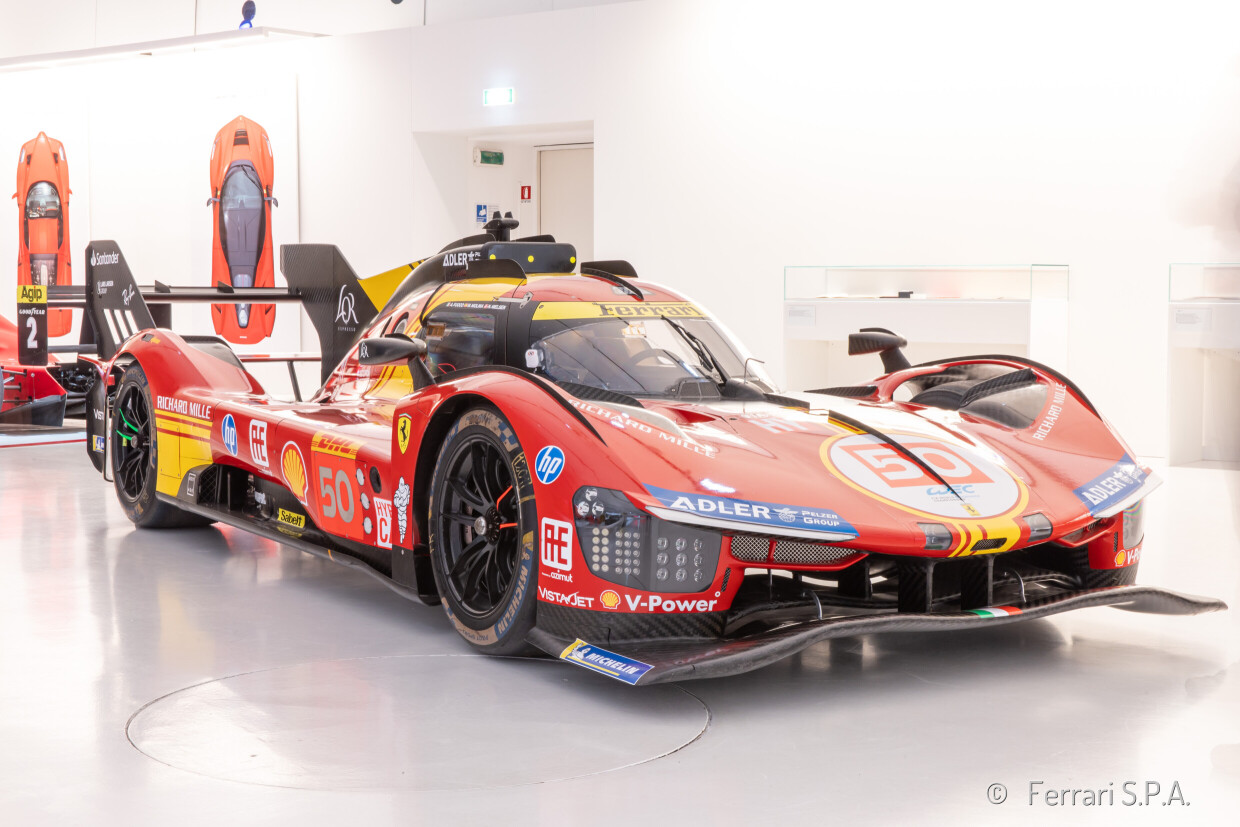
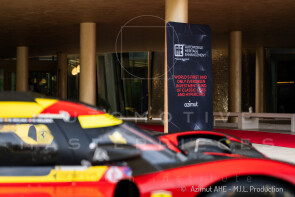
Ferrari return to top prototype class, 50 years after the 312 P. Test car at Portimão, Paul Ricard and Fiorano. Displayed in #50 livery at major Ferrari events.
Why am I an Automotive Masterpiece?
A. Concept and show cars
B. Prototypes
C. One-off models
D. Remaining cars from extremely limited production runs
E. Historic event cars
F. Cars owned by famous people
G. Team cars
H. Works cars
I. Press cars
J. Movie cars
K. Famous chassis’ cars
L. Limited edition cars
L. Limited edition cars
. Estimates suggest a small initial batch (≈5–7). A low-double-digit production is unconfirmed.
The Ferrari 499P is a sports prototype racing car, designed by the Maranello company according to the Le Mans Hypercar (LMH) regulations to compete in the FIA World Endurance Championship. The project was conceived under the direction of Antonello Coletta, Head of Endurance and Corse Clienti, who coordinated the strategic and technical effort that brought Ferrari back to the top class of endurance racing. The initial announcement of Ferrari’s participation in this class was made in February 2021, signaling its intention to re-enter top-level endurance competition, after fifty years of absence. The formal partnership with AF Corse, a long-standing partner in GT racing entrusted with supporting and assisting in the sporting management of the Hypercar program, was then publicly confirmed a few months later, on 7 June 2021. The first tests, with mules and semi-definitive prototypes, took place between 2022 and 2023 at Fiorano, Imola, Barcelona, Portimão and Monza, accumulating around 10,000 kilometers of running before the official presentation at the Finali Mondiali Ferrari in Imola in October 2022. The development program involved factory drivers Alessandro Pier Guidi and Antonio Fuoco, supported by Ferrari test driver Andrea Bertolini. The name 499P follows tradition: 499 is the unit displacement of each cylinder, while P stands for “prototipo”. The livery reprises the traditional Rosso Corsa, complemented by Giallo Modena details that recall the 312 P of the early Seventies, the last official Ferrari to compete in endurance racing, in a direct homage to the marque’s heritage. On the 2023 cars, the shade chosen—Rosso Le Mans—offered a slightly more orange hue, while from 2024 the color evolved into Rosso Racing, identical to that used on Ferrari’s Formula 1 cars, reinforcing the visual link between the endurance program and the brand’s top-tier motorsport identity. From a technical perspective, the 499P is powered by a hybrid powertrain: the internal combustion engine, a 120° V6 of 2994 cc with two parallel turbochargers, derives from that of the Ferrari 296 GT3 but with deep modifications. It is not mounted on an auxiliary subframe but acts as a structural element within a carbon fiber monocoque conceived and developed by Ferrari. The system’s total output is limited by the regulations to 500 kW, equivalent to 680 hp. Alongside the centrally mounted longitudinal engine, an electric motor-generator of 200 kW operates on the front axle, engaging beyond a minimum speed threshold imposed by the FIA and adjusted according to the balance of performance. The system is powered by a 900-volt battery—drawing on Formula 1 experience—recharged through energy recovery under braking and deceleration. Together, the two units form a temporary all-wheel-drive system, electronically managed to ensure performance balance and full regulatory compliance. The aerodynamics integrates refined solutions that, in accordance with LMH regulations, do not use standardized components as in the “LMDh” cars, and shows particular attention to efficiency and stability, exemplified by the distinctive triple-plane rear wing, designed to optimize downforce distribution while maintaining low drag. It is developed by Ferrari’s in-house engineering department under the direction of Ferdinando Cannizzo, and then refined in its external forms and harmonized with the marque’s stylistic language by the Centro Stile Ferrari led by Flavio Manzoni. The entire project was overseen by Antonello Coletta, who coordinated engineering, design and racing management within a single program structure. The return to competition came in the 2023 season. To celebrate the comeback after half a century, Ferrari entered two official cars: number 50 entrusted to Fuoco, Molina and Nielsen, and number 51 driven by Pier Guidi, Calado and Giovinazzi, reviving one of the most successful numbers in Ferrari tradition. On its debut at the 1000 Miles of Sebring, the 499P immediately took pole position and a podium; further placings confirmed its competitiveness, up to the queen of races, the 24 Hours of Le Mans, where Ferrari achieved overall victory with car number 51, breaking Toyota’s dominance and bringing the Cavallino back to triumph fifty-eight years after the success of the 250 LM in 1965. That victory, Ferrari’s tenth at Le Mans, coincided with the centenary of the race and marked the historic return of the Maranello marque to the top of world endurance. The season concluded with more podiums and second place among the manufacturers, behind Toyota. In the 2024 season, Ferrari confirmed its two official line-ups and expanded its presence with a third car — the number 83 entered by AF Corse and driven by Kubica, Švarcman and Ye. The 499P’s competitiveness was consolidated, with another overall victory at the 24 Hours of Le Mans — this time achieved by the crew of car number 50 — followed by further success at the Lone Star Le Mans in Austin, where the private 499P number 83 took a historic win. The Lone Star Le Mans victory coincided with Ferrari’s Formula 1 triumph at Monza. In the same season, Ferrari also achieved a rare distinction by winning two of the three races that make up motorsport’s “Triple Crown” — Monaco and Le Mans — with the Indianapolis 500 remaining the only missing leg. In 2025 the 499P confirmed its maturity: the two official cars and the private AF Corse entry dominated the first part of the championship with consecutive victories, including a one-two-three at the debut in the 1812 km of Qatar — the first in the endurance world championship since 1972 — followed by triumphs at Imola, Spa-Francorchamps and the 24 Hours of Le Mans, achieving three consecutive overall victories on the Sarthe as had not been seen in sixty years. The 499P carries an important historical significance: it is not just a racing prototype, but the synthesis of Ferrari’s past and future. On one side it celebrates the tradition of the Sports Prototypes that dominated in the Sixties and Seventies; on the other, it embodies technological evolution with hybrid power and advanced aerodynamics; a manifesto of Maranello’s will to remain a protagonist at the highest level of motorsport.
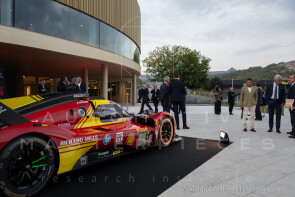
Ferrari 499P chassis n. F255 LMH 12 24 P is a test car produced by Ferrari as part of the development and consolidation program of the Hypercar project. This chassis took part in a series of private development test sessions: at Portimão on 26–28 March 2024, at Paul Ricard on 10–11 April 2024, and at Fiorano on 23–24 May 2024. In November 2024 the car was officially handed over to Azimut AHE, the world’s first evergreen investment fund dedicated to classic and historically significant automobiles. Under Azimut ownership, chassis 12 24 P adopted the racing number “50” livery, celebrating the successes of Ferrari’s Hypercar program at Le Mans with cars #50 and #51. Since then, it has been presented not in competition but as part of the fund’s strategy of enhancing Ferrari’s contemporary racing heritage. The car was exhibited at the Cavallino Classic Modena 2025, where Azimut, acting as main sponsor, displayed two Ferrari 499Ps including chassis 12 24 P. It was also displayed at the Motor Valley Fest 2025, held at the Museo Enzo Ferrari in Modena, as part of the celebrations dedicated to the excellence of Italy’s automotive heritage.